
Direct answer
Clearing a 3-bedroom house in London typically costs about £680 to £1,150 for a semi-detached and £850 to £1,400 for a detached house, and a 4-bedroom family house about £1,000 to £1,700. Those are the indicative ranges on our prices page, not a fixed rate card: a licensed carrier quotes the real price for your house and access.
Contents
- What a 3-bed or 4-bed house clearance costs in London
- What moves the price up or down
- Two worked examples of how a house quote adds up
- What is usually in each part of a house
- When weight matters more than volume
- Parking, access and the loading team
- Sorting a house: keep, sell, donate, dispose
- Reasons for clearing a 3-bed or 4-bed house
- A planning timeline for a larger house
- Houses across London: what changes by area
- Questions worth asking a carrier before you accept
- Comparing house clearance quotes
- Waste duty of care for a house clearance
- What happens on the day
- Related guides
- How to prepare for a house clearance
- How the process works, start to finish
- Frequently asked questions
What a 3-bed or 4-bed house clearance costs in London
Published ranges from our prices page.
Three and four-bedroom houses are priced by volume, weight and crew size. Our prices page publishes the ranges below.
| Property | Price range (excl. VAT) | Weight allowance | Loading time |
|---|---|---|---|
| 3-bedroom semi-detached house | £680 – £1,150 | Up to 1,000 kg | 2 – 3 hours |
| 3-bedroom detached house | £850 – £1,400 | Up to 1,300 kg | 3 hours |
| 4-bedroom large family house | £1,000 – £1,700 | Up to 1,800 kg | 3 – 5 hours |
A 3-bed semi is equivalent to roughly one to one and a half full Luton van loads. A 4-bed house usually needs a three-person crew or several vehicle trips. These are indicative ranges, and the price you pay is the quote from a licensed carrier for your actual house.
What moves the price up or down
Loft, garage, garden and how full it is.
- Outbuildings and loft. Lofts, garages, sheds and conservatories add volume. See our loft, garage and shed clearance guides.
- Stairs and access. Multiple floors increase labour. Stairs without a lift typically add about £30 to £60 per flight for the items concerned.
- Regulated items. Mattresses, sofas, fridges and TVs carry disposal surcharges listed on the prices page.
- Valuable items. The asset offset described on the prices page can reduce the net cost where items have resale value.
- Heavy or dense waste. Soil, rubble and similar materials are priced by weight, not volume.
Two worked examples of how a house quote adds up
Illustrative arithmetic from our published ranges, not real customer jobs.
A house quote is built from the property range, extra rooms and outbuildings, regulated items and access. The two examples below are made-up planning scenarios, not real jobs and not quotes. They add together figures from our prices page so you can see how a total comes together. Carriers are independent businesses and some fold items into the base price, so check what each quote covers before comparing.
Example A: a 3-bed semi with a full loft
Take a three-bedroom semi-detached house where every room is furnished and the loft holds boxes and old furniture. The published range is £680 to £1,150, with a weight allowance of up to 1,000 kg and 2 to 3 hours of loading. Suppose there are three double mattresses, a 3-seater sofa, two armchairs and a washing machine. The surcharges listed on the prices page would be £135 to £195 for the mattresses, £65 to £110 for the sofa, £70 to £110 for the armchairs and £30 to £50 for the washing machine, about £300 to £465 in total. A planning total is therefore about £980 to £1,615, before any loft access labour a carrier chooses to include.
Example B: a 4-bed family house with a garage and a conservatory
Now take a four-bedroom house with a garage full of stored items and a small conservatory with furniture in it. The published range for a 4-bedroom large family house is £1,000 to £1,700, with a weight allowance of up to 1,800 kg and a three-person crew or several trips. Adding two tall fridge freezers (£150 to £230) and four mattresses (about £140 to £210 if mixed single and double) gives roughly £290 to £440 in surcharges, taking the planning total to about £1,290 to £2,140. Conservatory structures and hot tubs are priced separately, as explained in our conservatory and hot tub guide.
| Line | Example A (3-bed semi) | Example B (4-bed house) |
|---|---|---|
| Base property range | £680 – £1,150 | £1,000 – £1,700 |
| Mattresses | £135 – £195 (three doubles) | £140 – £210 (four, mixed) |
| Sofa and armchairs | £135 – £220 | None listed |
| White goods | £30 – £50 | £150 – £230 (two tall fridge freezers) |
| Planning total | £980 – £1,615 | £1,290 – £2,140 |
Use totals like these to spot quotes that look out of line, either unusually low or unusually high, and ask the carrier to explain what they have assumed. The real price is always the quote you receive.
What is usually in each part of a house
Planning room by room helps you describe the job accurately.
A house clearance gets harder to estimate as the number of spaces rises. Walk through the property and note what is in each place, because the carrier will price the whole picture. The notes below point out the items that most often change a quote.
Ground floor and kitchen
Living room furniture, dining sets and kitchen appliances account for much of the weight. A tall fridge freezer carries £75 to £115 and an American-style double door unit £120 to £190 on our prices page. Our fridge freezer disposal guide explains why, and the sofa removal guide covers upholstered items.
Upstairs bedrooms
Beds, wardrobes and chests of drawers need dismantling or careful carrying. Fitted wardrobes are different from freestanding ones and should be mentioned. Our wardrobe and bed removal guide and mattress disposal guide give more detail.
Loft, garage and shed
These are where volume hides. A loft hatch limits what can be passed down, and a garage can hold years of stored goods, paint and tools. Heavy items such as old car parts, tiles or bags of cement are charged by weight rather than volume. Read the loft, garage and shed guides before you post.
Garden and conservatory
Garden furniture, trampolines, greenhouses and compost bins add volume, and green waste is billed on its own rate on our prices page. See the conservatory and hot tub guide for larger structures.
When weight matters more than volume
A house can hit the weight limit before the van looks full.
Our prices page explains that carriers charge for volume on most household loads, but for dense materials they charge by weight because a van reaches its legal road capacity long before it looks full. Houses often include some of these materials, especially if renovation, garden work or old building materials are involved.
| Material | Unit | Indicative price |
|---|---|---|
| Inert builders waste (brick, concrete, stone) | Per tonne | £180 – £260 |
| Soil, clean earth, clay | Per tonne | £190 – £280 |
| Plasterboard and gypsum products | Per tonne | £240 – £360 |
| Mixed construction or renovation waste | Per tonne | £220 – £320 |
| Green garden waste | Per tonne or volume | £140 – £220 |
If your house has leftover rubble, soil or plasterboard, say so and give a rough amount. For larger quantities you may find it cheaper to separate the dense waste from the household contents. Our bricks and rubble guide and skip hire price guide help you decide whether a skip is a better fit for the heavy part.
Parking, access and the loading team
Houses are easier than flats, but not always easy.
- Driveway or street. A driveway lets the vehicle stand beside the door. A terraced street may mean a long carry, and a narrow road may limit the size of vehicle.
- Controlled parking. The prices page notes that carriers may need a visitor permit or include a council suspension fee, ranging from £35 to £90 per day depending on the borough.
- Congestion Charge and ULEZ. The standard daily Congestion Charge is £18 where it applies, and non-compliant heavy vehicles can face the £12.50 ULEZ charge. Whether it affects your price depends on the vehicle and route, so confirm with the provider.
- Stairs and tight turns. Narrow landings and steep stairs slow carrying. The published stair allowance is typically £30 to £60 per flight.
- Neighbours. Let neighbours know when a larger vehicle will be outside, especially on shared drives or private roads.
A 4-bedroom house is described on the prices page as needing a three-person crew or multiple vehicle dispatches, so parking for more than one trip may matter. Tell the carrier if the road has restrictions at certain hours.
Sorting a house: keep, sell, donate, dispose
The less that goes to disposal, the lower the volume you pay for.
Because houses hold more, there is more scope to reduce the cost by sorting before the carrier arrives. Items you sell or donate do not need to be priced for removal, and valuable pieces may reduce the net cost through the asset offset on our prices page.
- Keep: documents, photographs, jewellery, keys and sentimental items. Put them in one safe room and tell the crew the room is off limits.
- Sell: furniture and electronics in working condition. Marketplaces and auction houses are options, but be realistic about time.
- Donate: check the charity's rules first, since many cannot take upholstered items. See our furniture donation guide.
- Council bulky waste: useful for single items, but you usually have to book and put them out. Compare in our council versus private clearance guide.
- Dispose: everything else, listed in the job description with photos.
Our house clearance checklist and bulky item preparation guide give longer lists.
Reasons for clearing a 3-bed or 4-bed house
The circumstance affects timing, paperwork and who needs to be present.
- Selling or moving. The completion date drives the schedule. Read our urgent clearance guide if time is short.
- Probate and bereavement. There may be legal steps before items are disposed of. See the probate guide and bereavement guide.
- Landlords. Left-behind belongings need care; see the landlord and HMO guide.
- Downsizing. You have more time, so staged sorting and a partial clearance may make sense.
- Renovation. A clear-out before building work often includes rubble or old fittings, which are priced by weight.
If the house is very full, read the hoarding clearance guide, because our prices page notes that deep sorting and contamination can add 50% to 100% to standard labour rates.
A planning timeline for a larger house
Starting early keeps the cost and the stress down.
A three or four-bedroom house is rarely cleared in a single afternoon of decisions. If you have the luxury of time, a staged approach makes the final clearance smaller and cheaper, and it gives you room to deal with things that cannot simply be loaded onto a van.
| When | What to do |
|---|---|
| Four to six weeks before | Walk the house, list rooms and outbuildings, decide the keep pile and start selling or donating. |
| Two to three weeks before | Separate hazardous items, paint and gas bottles, check loft and garage, and take photographs of every space. |
| One week before | Post the job, compare quotes, confirm parking and access, and warn neighbours or a managing agent. |
| Day before | Clear a route through the house, remove personal papers and valuables, and check the lift or driveway is free. |
| Day of clearance | Walk through with the crew, confirm scope, and collect the invoice and waste transfer note. |
If your timeline is shorter, the same steps still apply, just compressed. Short notice can affect the price, as explained in the urgent clearance guide linked above.
Houses across London: what changes by area
Parking and access vary more than the furniture does.
A semi in an outer borough with a driveway and a terrace in a central controlled parking zone can contain the same furniture but cost differently to clear. Outer areas tend to offer easier kerbside access, though longer travel distances can matter, while inner areas are more likely to involve permits, red routes and congestion factors. Our prices page covers all 32 London boroughs and the City of London, and carriers covering your postcode will price to your real access.
- Terraced and mews houses. Narrow frontages and limited parking mean a longer carry and sometimes smaller vehicles.
- Semi-detached and detached houses. Driveways make loading simple, but garages and gardens often add extra volume.
- Period houses. Steep, narrow stairs and cellars can slow work. See the basement and cellar clearance guide if there is a lower level.
Mention your road type and parking arrangements in the job description, and add photos of the frontage if access looks tight.
Questions worth asking a carrier before you accept
A few minutes on the phone can save a disputed bill.
- Is the quote a fixed price for the scope I described, or can it change on the day?
- Which items does it include, and which are listed as surcharges?
- How many people and what size of vehicle are coming, and how many trips are planned?
- What is your waste carrier registration number?
- Will I receive a waste transfer note and an invoice?
- What happens if you find more than I described, such as a full loft?
- What happens to items that could be reused or recycled?
Carriers on houseclearance.co are independent and set their own prices. A good carrier answers these questions plainly, and you can decline any quote that leaves too much vague.
Comparing house clearance quotes
Same scope, same surcharges, same paperwork.
| Check | What to look for |
|---|---|
| Rooms and outbuildings | Every room, the loft, garage, shed and garden are listed |
| Surcharges | Mattresses, sofas, white goods and TVs shown as included or extra |
| Crew and vehicles | Number of people, vehicle size and whether more than one trip is planned |
| Time | Expected arrival and how long the work should take |
| VAT | Whether VAT applies, since carriers are independent businesses |
| Paperwork | Invoice and waste transfer note for your records |
Our licensed company guide covers registration checks. You have no obligation to accept any quote, and a lower price is not better if the scope is smaller.
Waste duty of care for a house clearance
Your responsibility does not end when the waste leaves the door.
A house clearance can generate several tonnes of waste, and handing it to an unregistered person can leave you responsible if it is dumped. Use a carrier registered to carry waste, check the number on the government register and keep a record. Fly-tipping is a problem we take seriously, and further background is in the Fly-tipping overview.
Ask for a waste transfer note and an invoice, and keep them with the sale or probate paperwork. Our waste transfer notes guide and invoices and records guide explain what each should show.
What happens on the day
A realistic timeline.
- Arrival and walk-through. The crew compares the house with the job description and agrees any changes.
- Loading. The published times are 2 to 3 hours for a 3-bed semi, 3 hours for a detached 3-bed and 3 to 5 hours for a 4-bed, based on a normally furnished house.
- Sorting. The prices page notes one hour of on-site sorting labour in the baseline, which helps when you have not sorted everything.
- Sweep and final check. Walk every room, the loft and garage, and check you have your keys, papers and meter details.
- Paperwork. Take the invoice and waste transfer note before the crew leaves.
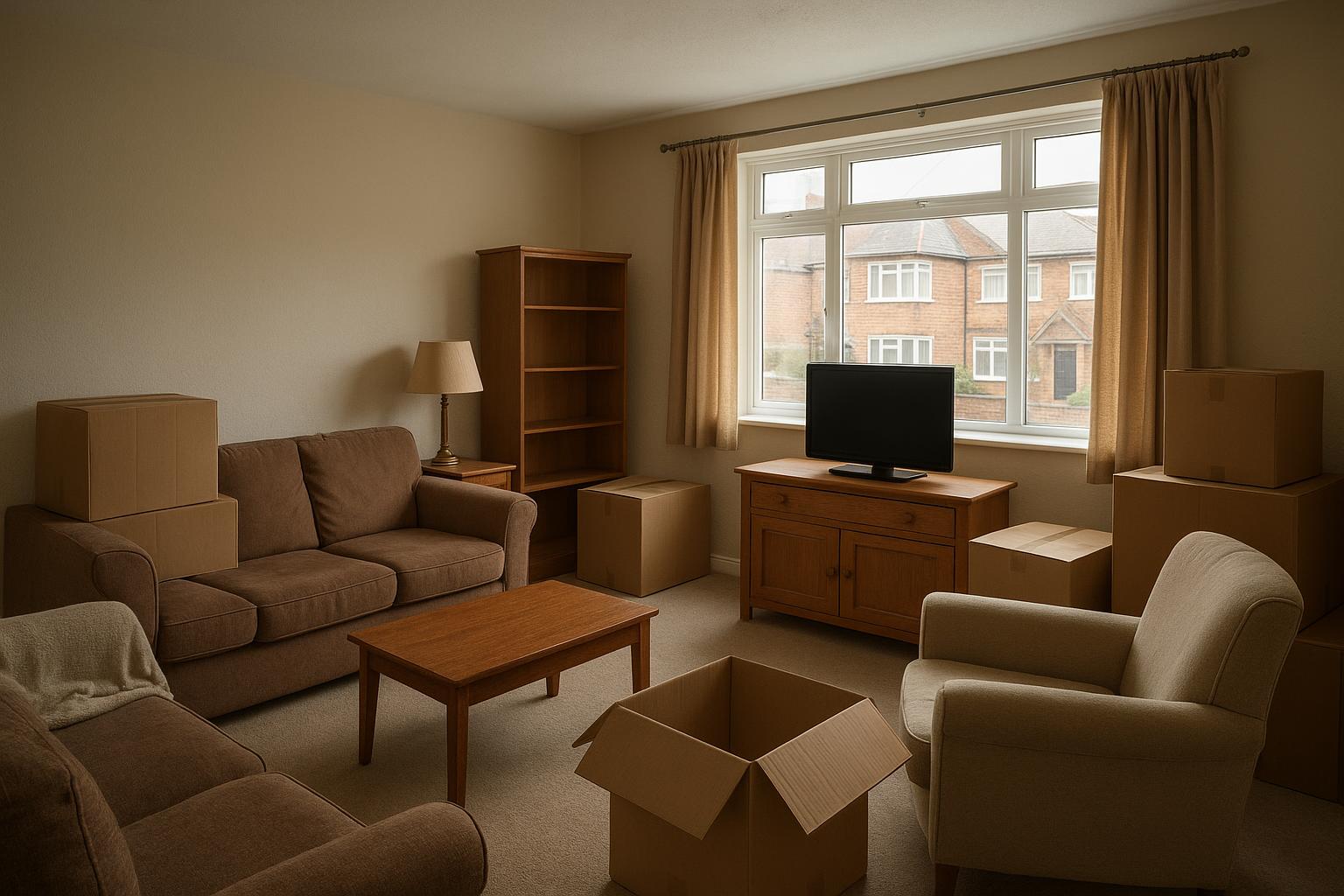
How to prepare for a house clearance
Sort first, quote second.
- Photograph every room, the loft, garage and garden.
- Decide what you are keeping, and check for papers, keys and valuables.
- Note parking, access and whether neighbours or a managing agent need warning.
- Say if power or water is off.
Our house clearance checklist and guide to choosing a licensed company help you plan.

How the process works, start to finish
Three steps from description to collection.
Describe the job
Say what size of house it is and what must go, roughly how much there is and anything you want to keep.
Add access and timing
Mention parking, loft, garage and garden access, and your deadline.
Get a carrier quote
Post the job, compare licensed carriers' quotes and choose, with no obligation to accept.
Frequently asked questions
How much does a 3-bedroom house clearance cost in London?
Our prices page gives an indicative £680 to £1,150 for a semi-detached house and £850 to £1,400 for a detached house.
How much does a 4-bedroom house clearance cost?
An indicative £1,000 to £1,700 for a large family house.
How long does it take?
Typically 2 to 3 hours for a 3-bed semi and 3 to 5 hours for a 4-bed, depending on how full it is.
How many vans will it need?
A 3-bed semi is roughly one to one and a half Luton van loads, and a 4-bed may need several trips or a larger crew.
Does the price include the loft and garage?
Only if you tell the carrier. Post them in the job description so the quote covers them.
Can valuable items reduce the price?
Possibly. Some carriers may factor in resale value, but there is no guarantee of a discount.
Is a detached house more expensive to clear than a semi?
On our prices page the detached 3-bed range is £850 to £1,400, higher than the £680 to £1,150 semi range, usually because of more space and outbuildings.
What if there is rubble or soil in the garden?
Those are priced by weight, from £180 to £280 per tonne on the published table. Say how much there is.
How many people will turn up?
A 4-bed house usually needs a three-person crew, but the carrier confirms this in the quote.
Should I sort before they arrive?
Yes. Sorting reduces volume, and the baseline only includes about one hour of on-site sorting.
Do I need to be at the house?
Usually someone should be present or arrange access and sign off. Say in your post who will be there.
Will they leave the house clean?
Clearance is not cleaning, though many carriers sweep up. If you need a deep clean, arrange it separately.
Ready to see your price?
Post your house clearance for licensed carriers to quote on.