
Direct answer
Removing bulky furniture in London typically costs about £45 to £65 for an assembled single wardrobe, £50 to £70 for a dismantled bed with frame and £70 to £100 for a dining table with chairs. Those are indicative ranges, not a fixed rate card: houseclearance.co publishes a single-item minimum on /prices/, and a licensed carrier quotes the real price for your items and access.
Contents
- What wardrobe, bed and bulky furniture removal costs in London
- Single-item minimums and van-fraction pricing
- Worked examples: how a furniture job can add up
- What moves the price up or down
- Furniture types and what each one needs
- Stairs, lifts and doorways in London homes
- Differences across London boroughs
- Item guides and related options
- Selling, donating, council or private collection
- How to prepare furniture for collection
- Dismantling safely before collection
- What to check when you compare furniture quotes
- Waste rules you should know about
- How the process works, start to finish
- Common situations where bulky furniture removal comes up
- Frequently asked questions
What wardrobe, bed and bulky furniture removal costs in London
Per-item indicative ranges, not a rate card.
Single bulky pieces are usually priced per item, with the price rising for size, whether it has been taken apart and how hard the route is. The ranges below are indicative for London. Our prices page lists mattress and sofa disposal surcharges separately, and publishes a single-item minimum collection charge for small jobs.
| Item | Indicative price | Notes |
|---|---|---|
| Single wardrobe (assembled) | £45 – £65 | Often needs two people |
| Dismantled bed with frame | £50 – £70 | Add the mattress separately |
| Dining table with chairs | £70 – £100 | Depends on table size and chair count |
| Single-item minimum (from /prices/) | £65 – £95 | Published minimum for one-item collections |
The figures in the first three rows are planning ranges. Where an item is collected alone, the carrier may apply the single-item minimum shown on our prices page, so check which applies when you compare quotes.
Single-item minimums and van-fraction pricing
Why one wardrobe can cost more than the table suggests, and when to group items.
The per-item ranges above are useful for planning, but carriers do not always price piece by piece. Our prices page publishes a single-item minimum charge of £65 to £95 for a collection of one item of roughly 1 to 2 cubic yards, and it also lists how larger loads are priced by the fraction of a standard Luton van. Those published van-load figures are shown below so you can see how a handful of furniture pieces compares with a single item.
| Load | Cubic capacity | Indicative price |
|---|---|---|
| Single item minimum charge | 1 – 2 cu yd | £65 – £95 |
| 1/8 van load | 2 cu yd | £95 – £135 |
| 1/4 van load | 4 cu yd | £145 – £195 |
| 3/8 van load | 6 cu yd | £210 – £265 |
| 1/2 van load | 8 cu yd | £275 – £345 |
These are the platform's published indicative ranges for general waste, and they exclude any regulated-item surcharge such as a mattress charge. The practical lesson is that the cost of the next item is usually much lower than the cost of the first. A wardrobe on its own may fall under the single-item minimum, while a wardrobe, bed frame and two chairs together can fit within a quarter van load. That is why we recommend listing everything you want gone in the same job.
Worked examples: how a furniture job can add up
Illustrative arithmetic using the published and indicative ranges, not real customer jobs.
The scenarios below are planning examples only. They are built from the ranges in this guide and our prices page, and they are not records of real jobs or guaranteed quotes.
Scenario 1: one assembled single wardrobe, ground floor
The indicative range is £45 to £65, but a carrier may apply the single-item minimum of £65 to £95 for a lone item. If you also have a bedside cabinet or a spare chair, add them to the same post. The extra pieces usually fit in the same van space and may bring the per-item cost down.
Scenario 2: a double bed frame and mattress, first floor
A dismantled bed with frame is indicatively £50 to £70. A double or king mattress carries its own published disposal surcharge of £45 to £65. One flight of stairs without a lift typically adds about £30 to £60. Adding these together gives a planning range of about £125 to £195 before any saving from a combined visit. Our mattress removal cost guide covers the mattress part in more depth.
Scenario 3: a whole bedroom, second floor, no lift
A wardrobe (£45 to £65), a dismantled bed (£50 to £70), a mattress (£45 to £65 surcharge) and a chest of drawers could together approach a quarter van load, which our prices page lists at £145 to £195 before stairs and surcharges. Two flights could add roughly £60 to £120. The most reliable route to an accurate figure is simply to post the full list and let carriers quote the whole job.
What moves the price up or down
Assembled or flat-packed, stairs and number of items.
- Assembled or dismantled. A flat-packed wardrobe is quicker to carry than an assembled one. Taking it apart yourself can reduce the quote.
- Stairs. Our prices page notes about £30 to £60 per flight without a lift.
- Mattress and bed base. A mattress carries its own disposal charge: see the mattress removal cost guide.
- Several items. The more you add to one visit, the lower the per-item price usually is. See the furniture and bulky item removal cost guide.
Furniture types and what each one needs
Different pieces create different handling problems.
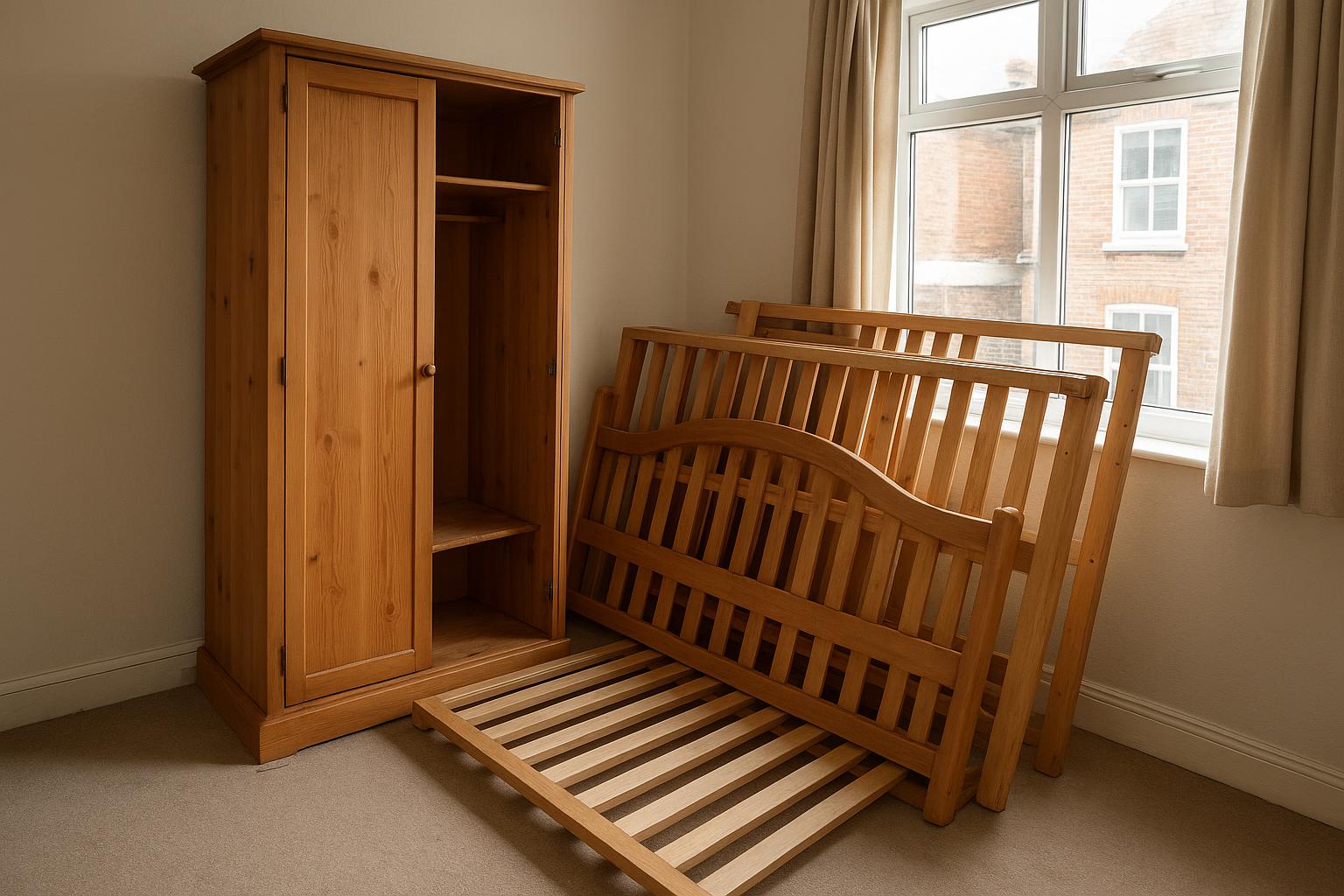
- Freestanding wardrobes. Tall, top-heavy and often fragile at the back panel. They go down stairs more safely when the doors and shelves are removed and the crew has two people.
- Fitted and built-in wardrobes. These are fixed to the wall, floor or ceiling and need to be removed before they can be collected. Our fitted wardrobe removal guide explains what the job involves and who should do the stripping.
- Divan beds. A divan base is a solid box that does not dismantle, so check that it will come out through the door. Storage divans with drawers should be emptied first.
- Bed frames, metal and wooden. Most come apart with a few bolts. Keep the bolts in a bag. See our bed frame removal guide.
- Bunk beds. Long rails and ladders. Take them apart if the manufacturer allows it.
- Chests of drawers and cabinets. Remove the drawers and carry them separately, since they are usually the heaviest and the most likely to slide out.
- Dining tables and chairs. A solid wood or glass top table is heavy and needs extra care. Our dining table and chairs guide covers the detail.
- Sofas and upholstered pieces. These carry a disposal charge, discussed in the sofa removal cost guide.
Stairs, lifts and doorways in London homes
Most extra cost on furniture comes from access.
Furniture is heavy but it is also an awkward shape, so the route out matters as much as the weight. Our prices page says standard pricing assumes ground-floor access or a direct service lift, and that carrying down stairs without a lift typically adds about £30 to £60 per flight. A third-floor walk-up can therefore change a quote noticeably.
Before you post, walk the route with a tape measure. Measure the widest part of the piece, the width of your internal doors, the narrowest point of the stairwell and any turn at a half-landing. A wardrobe that was built in the room or carried up before the stair banister was fitted may not come out in one piece. If you cannot dismantle it, say so; a carrier would rather plan for it than discover it on the day.
Parking is the second access factor. Our prices page notes that parking on yellow lines, red routes or in controlled parking zones may require a visitor permit or a council suspension, with fees of about £35 to £90 per day depending on the borough. If you live in a street where parking is difficult, mention it, because the carrier may include the cost or ask you to arrange a permit. For central areas, see also London congestion zone tips.
Differences across London boroughs
The same wardrobe can be a different job in different parts of the city.
London is 32 boroughs plus the City, and the local environment affects furniture removal more than the furniture does. In central areas, parking restrictions, loading rules and the Congestion Charge are the main factors. Our prices page lists the standard £18 daily Congestion Charge where applicable, and notes that suspension fees of about £35 to £90 per day depend on the borough. Whether any of this lands in your quote depends on the vehicle, the route, the time and what the provider has included.
In outer boroughs, driveways and on-street parking are more common, so access is usually easier, but houses have more stairs and sometimes loft or garage storage. Council bulky waste schemes also differ, as you can see from our pages for Brent, Ealing, Harrow, Hillingdon and Hounslow. Check your own council's current rules before assuming a free or low-cost slot is available.
Carriers on the platform cover specific postcodes, so when you post the job it is shared with those who work in your area. That is why entering the correct postcode and access details matters more than choosing a borough from a list.
Item guides and related options
Detail for specific pieces.
For specific pieces, see our guides to bed frame removal, fitted wardrobe and built-in furniture removal and dining table and chairs removal. If the pieces are in good condition, our furniture donation guide explains what charities accept. For larger jobs, furniture collection and disposal covers all the options.
Selling, donating, council or private collection
Choose the route that fits the condition and timing.
Not all furniture has to go to waste. A wardrobe in good condition is easy to sell or give away locally if you are flexible, and charities may take solid pieces with the right labels. The catch is the time it takes and the conditions attached. Our furniture donation guide lists common rules, and furniture collection and disposal compares the main ways to clear furniture.
| Route | Best for | Main limit |
|---|---|---|
| Sell or give away locally | Good-condition wardrobes, tables and bed frames | You arrange the collection and the buyer must be able to move it |
| Charity or reuse scheme | Clean, sound furniture | Items must meet their conditions, and they may not collect from upper floors |
| Council bulky waste | Planned clear-outs where you can leave items outside | Fees and rules vary by borough; see our council versus private guide |
| Private licensed carrier | Multiple items, upper floors, fixed dates | You pay a quote, but the carrier collects from inside and clears the space |
If you are not sure whether to sell or dispose, a good test is whether you would be happy to take a photograph and spend an hour replying to messages. If not, the time saved by a single carrier visit often outweighs the small amount you might get from selling.
How to prepare furniture for collection
Small steps that make a collection quicker.
- Empty wardrobes, drawers and storage beds completely.
- Dismantle if you can, and keep screws in a bag taped to the item.
- Measure doorways and stairs for large pieces.
- Say whether the item is fixed to a wall, as fitted pieces take longer.
Our bulky item preparation guide has a fuller checklist.
Dismantling safely before collection
What you can do yourself, and what to leave to the crew.
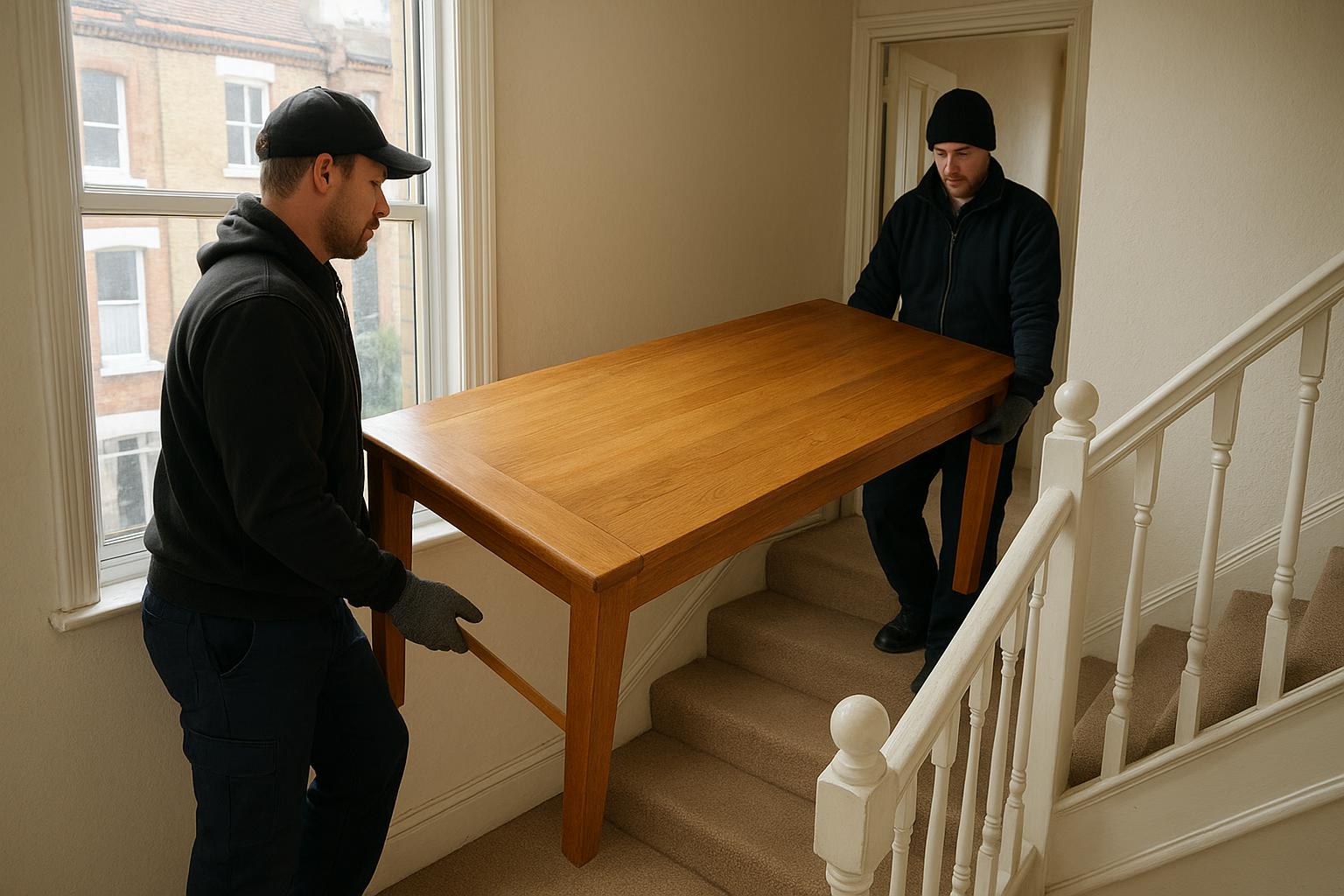
Taking furniture apart yourself can speed up a collection, but only if you are comfortable doing it safely. Our guide to moving heavy furniture safely covers lifting technique and equipment. These are the common steps.
- Remove doors, shelves, rails and drawers from wardrobes and chests of drawers and carry them separately.
- Unbolt bed frames and slats and tie slats together so they do not scatter.
- Put all screws, bolts and fixings in a labelled bag and tape it to the largest part, in case a buyer or charity needs them.
- Lay a blanket or old towel on the floor to protect stairs and hallways.
- Do not attempt to dismantle fitted furniture that is fixed to walls if you are unsure about electrics, plumbing or plasterwork behind it.
If a piece is too large, too fragile or too stiff to dismantle, leave it assembled and tell the carrier. They have tools and enough hands to deal with it, and the quote will reflect it.
What to check when you compare furniture quotes
Check scope, not just the headline figure.
- Item list. Does the quote list every item, including mattresses, which carry a separate charge?
- Stairs and floors. Is the stair supplement included, or added on the day?
- Minimum charge. Is a single-item minimum being applied?
- Dismantling. Who will do it, and is it included?
- Registration. Does the carrier hold a waste carrier registration? See the government's waste carrier registration page and our guide to choosing a licensed company.
- Time window. When exactly will the crew arrive?
You can post the job, receive quotes from carriers covering your postcode, ask them questions and decline all of them if none suit. There is no obligation to accept.
Waste rules you should know about
Furniture is household waste, and you stay responsible for it until it reaches a proper destination.
Furniture counts as household waste, and householders in England have a duty of care to hand it only to a council service, a registered waste carrier or a genuine reuse organisation. Our householder duty of care guide explains what this means for you. In practice, use a carrier who can show a waste carrier registration and who will tell you where the items are going. If furniture is dumped on the street after leaving your home, it can be traced back, which is why a cheap kerbside deal with no paperwork carries risk. For background on the wider problem, see fly-tipping.
Some furniture items need separate handling. Mattresses and upholstered chairs carry published disposal surcharges on our prices page because they cannot be mixed with general waste. Solid wood and metal furniture is usually easier to recycle, which is one reason a wardrobe or table is often cheaper to remove than a sofa of the same size.
How the process works, start to finish
Three steps from description to collection.
Describe the job
Say what items you want collected, roughly how much there is and anything you want to keep.
Add access and timing
Mention the floor, lift, doorways and where a vehicle can park.
Get a carrier quote
Post the job, compare licensed carriers' quotes and choose, with no obligation to accept.
Common situations where bulky furniture removal comes up
The context changes what you should tell the carrier.
- Replacing a bedroom set. Often a wardrobe, bed and drawers in one go. Ask for the whole set to be collected on the same morning the new furniture arrives, and check that the retailer is not already offering a take-away service for old items.
- End of tenancy. Deposits and handover dates make timing tight. Mention your key-return date, and see our landlord and HMO clearance cost guide if you are clearing a rental property.
- Downsizing or moving. Furniture removal is often part of a wider clearance. Our 1 and 2 bed flat clearance cost guide shows how whole-flat jobs are priced, and the house clearance cost guide covers larger properties.
- Flat-pack furniture that has failed. Chipboard wardrobes that have collapsed can be sharp-edged and awkward. Say so, and wear gloves if you are tidying it.
- Inherited furniture. Solid older pieces can have real value. Before booking disposal, ask whether it is worth getting an opinion, or see the donation guide for reuse routes.
In each case the principle is the same: give the carrier an honest list, the floor and access details, and your preferred date. A clear description gives you a quote you can rely on and avoids changes on the day.
Frequently asked questions
How much does it cost to remove a wardrobe in London?
Indicatively £45 to £65 for an assembled single wardrobe. The real price is the quote you receive.
How much does bed removal cost?
Indicatively £50 to £70 for a dismantled bed with frame, plus the mattress charge if there is one.
Is it cheaper if I dismantle the furniture first?
Often yes, because it is quicker to carry and load. Tell the carrier what state it is in.
Is there a minimum charge for one item?
Our prices page publishes a single-item minimum of about £65 to £95, so very small jobs are best combined.
Will a carrier take a fitted wardrobe?
Often, but it needs to be removed from the wall, which takes time. See our fitted wardrobe guide.
Can I donate furniture instead?
Sometimes. Charities may take items in good condition, but rules differ, so check before arranging collection.
How much does it cost to remove a chest of drawers?
There is no single published figure for it on our prices page. A chest of drawers is a smaller item than a wardrobe, so it is usually grouped with other furniture. If it is the only item, the single-item minimum of £65 to £95 may apply.
Do I need to take the doors off a wardrobe?
It is not required, but removing doors, shelves and drawers makes the wardrobe lighter and easier to carry. If you do, say so when you post.
Is a divan bed charged differently from a normal bed frame?
A divan base is a solid piece that cannot be taken apart, so it can take more effort than a slatted frame. The mattress on top carries its own disposal charge.
What happens if the furniture will not fit through the door?
Tell the carrier when you post. They may need to dismantle it or cut it up, which can add time and affect the price. If it will not come out at all, ask them about the options before the day.
Can furniture be collected from a flat with no lift?
Yes. Our prices page notes that carrying down stairs without a lift typically adds about £30 to £60 per flight, so mention the floor when you post.
Is it cheaper to put furniture out for the council?
It can be, but councils vary in fees, booking waits and what they will take, and most need items to be put outside. A private carrier collects from inside and fits around your dates.
Ready to see your price?
Post your furniture removal job for licensed carriers to quote on.