
Direct answer
Clearing a room after a tenant in London typically costs about £120 to £250, and a whole HMO house of mixed waste about £800 to £1,800. Those are indicative ranges, not a fixed rate card: a licensed carrier quotes the real price for your property, volume and deadline.
Contents
- What landlord and HMO clearance costs in London
- What moves the price up or down
- Check before you clear a tenant's belongings
- Worked examples of landlord and HMO quotes
- What is different about an HMO
- A tenant-turnover checklist for landlords
- Hazards and difficult items in rental properties
- Access, keys and parking for rental clearances
- Managing several properties or recurring turnovers
- Ways landlords can reduce the cost of a turnover
- Left-behind belongings: what to keep records of
- Furnished and unfurnished lets
- Gardens, bin stores and communal areas
- What happens on the day of a turnover
- Comparing landlord clearance quotes
- Waste duty of care for landlords
- Related guides
- How the process works, start to finish
- Frequently asked questions
What landlord and HMO clearance costs in London
Indicative ranges for room turnovers and whole houses.
Landlords usually need either a single room cleared between tenants or a whole house of shared accommodation cleared in one go. Our prices page publishes property-size ranges and a van-load table, and the figures below are indicative planning ranges for these two common cases.
| Job | Indicative cost | Notes |
|---|---|---|
| Room cleared after a tenant (left items and a mattress) | £120 – £250 | Includes disposal of abandoned belongings |
| Whole HMO house (mixed waste) | £800 – £1,800 | Depends on rooms, volume and shared areas |
The price is driven by how much was left and how many rooms need clearing. A mattress, sofa or fridge adds its own surcharge from the prices page.
What moves the price up or down
Number of rooms, volume and condition.
- Number of rooms. A full turnover of a multi-room house costs far more than a single room.
- Abandoned contents. Furniture, mattresses, white goods and bags of rubbish all add volume and surcharges.
- Condition. Heavy clutter or squalor takes longer. See the hoarding clearance cost guide where that applies.
- Timing. Quick turnarounds between tenants may raise the price.
- Access. Stairs, parking and shared entrances all matter in multi-let houses.
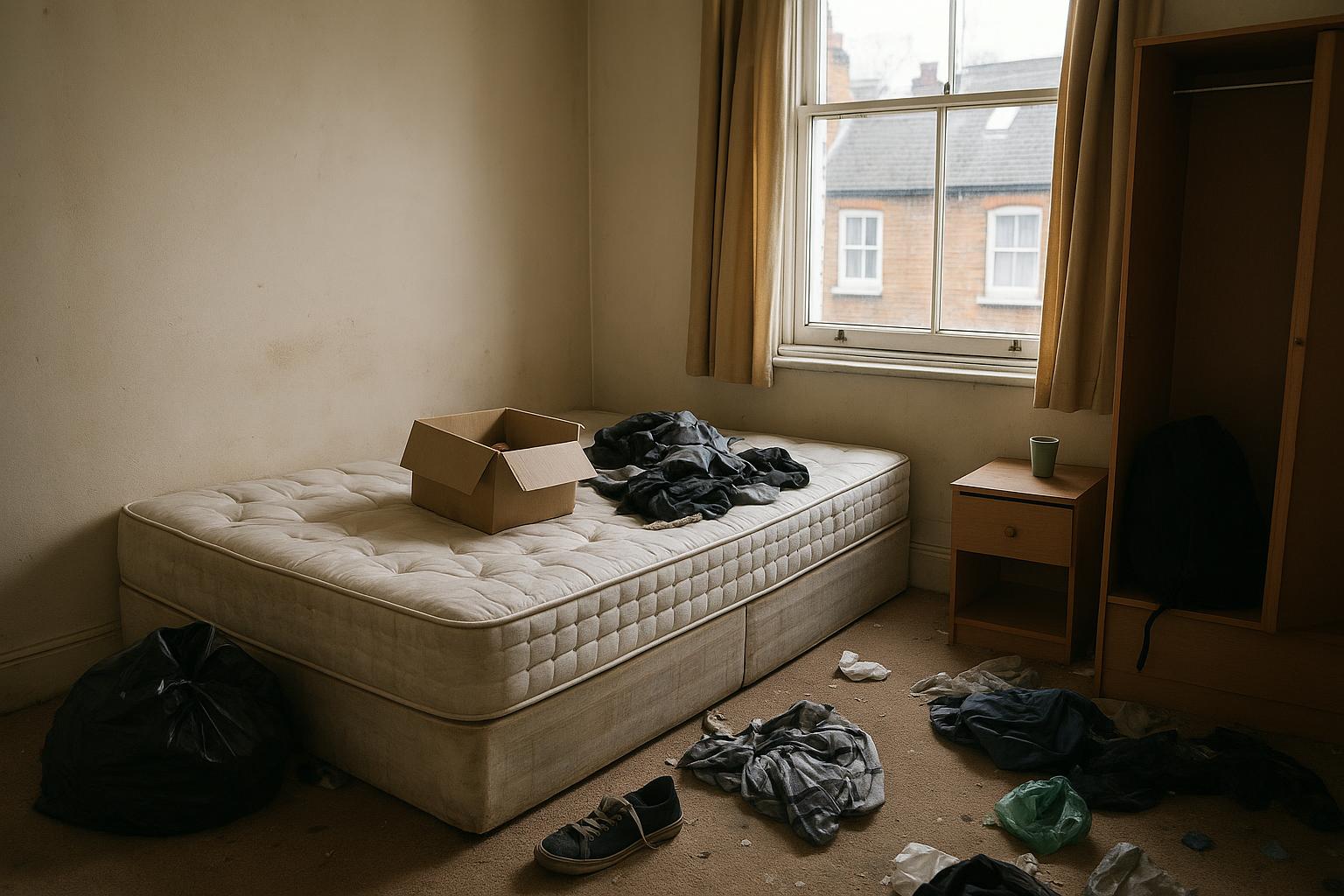
Check before you clear a tenant's belongings
Do not assume you can dispose of what was left.
Before clearing belongings left by a tenant, check the tenancy agreement and take advice on your legal position, because disposing of someone else's goods too early can create problems. Keep photographs and records of what was removed. Our guide to invoices and records and waste transfer notes guide explain what paperwork to keep. This is general information, not legal advice.
Worked examples of landlord and HMO quotes
Illustrative arithmetic from our indicative ranges, not real jobs.
Landlord clearances vary hugely, from one abandoned mattress to an entire shared house. The scenarios below are made-up planning examples, not real jobs and not quotes. They combine the indicative ranges in this guide with the surcharges published on our prices page so you can see how a total builds up. Carriers are independent businesses and some include items in the base figure, so always check what each quote covers.
Example A: one room after a tenant, with a mattress and a sofa left behind
The indicative range for a single room is £120 to £250, including the disposal of left items and a mattress. If a 2-seater sofa and a small under-counter fridge were also left, and the carrier lists them separately, the prices page shows £50 to £85 for the sofa and £45 to £70 for the fridge. That makes the planning total about £215 to £405.
Example B: a five-room HMO turned over in one visit
For a five-bedroom shared house with mixed waste, the indicative whole-house range is £800 to £1,800. Suppose four double mattresses, two sofas, a tall fridge freezer and a washing machine are included. The published surcharges would be £180 to £260 for the mattresses, £100 to £170 for two 2-seater sofas, £75 to £115 for the fridge freezer and £30 to £50 for the washing machine. If listed separately, the total moves to about £1,185 to £2,395. Many carriers will fold some of this into the headline figure, so compare the scope as well as the number.
| Line | Example A (one room) | Example B (five-room HMO) |
|---|---|---|
| Base indicative range | £120 – £250 | £800 – £1,800 |
| Mattresses | Included | £180 – £260 (four doubles) |
| Sofas | £50 – £85 | £100 – £170 (two 2-seaters) |
| White goods | £45 – £70 | £105 – £165 |
| Planning total | £215 – £405 | £1,185 – £2,395 |
The point is to see which lines can move the total, not to predict it. Mattresses and white goods are the usual culprits in multi-let houses, because every bedroom has one.
What is different about an HMO
Shared houses create access, volume and responsibility questions that single lets do not.
A house in multiple occupation usually has several tenants sharing kitchen, bathroom or living space. When one tenant leaves, only one room may need clearing, but the rest of the house is still occupied. When the whole house is cleared, shared areas such as the kitchen, hallway and garden add a large amount of volume on top of the bedrooms.
- Occupied houses. Clearing one room while others live there means careful timing, notice to residents and sensible protection of shared stairs and corridors.
- Shared kitchens. Multiple fridges, microwaves and cupboards mean more small electronics and surcharges. Small domestic electronics on our prices page are £10 to £20 per unit.
- Every room has a bed. A mattress is £25 to £40 for a single and £45 to £65 for a double or king on the prices page, and that multiplies across rooms.
- Communal waste. Shared bin areas and gardens often hold bulky items left over several tenancies.
- Licensing and regulation. HMOs can be subject to licensing and safety rules that vary by council. Check your own council's requirements, as this guide does not cover them.
Tell the carrier whether the house is occupied, how many rooms are included and whether shared areas are part of the job. The whole-house indicative range of £800 to £1,800 assumes mixed waste, so say if the house is very full.
A tenant-turnover checklist for landlords
A repeatable routine saves money across lets.
Landlords who handle many turnovers benefit from a routine. The sequence below is general guidance, not legal advice, and you should adapt it to your tenancy agreements and local rules.
- Before the tenancy ends. Remind the tenant in writing of the end date and ask them to remove their belongings. Keep copies.
- At the final inspection. Photograph every room, cupboard and outbuilding with date stamps.
- Record what is left. List items by room, noting whether they appear to be rubbish or belongings. Do not dispose of anything of apparent value without taking advice.
- Separate your own items. Furnished lets include landlord-owned furniture. Mark it so it is not removed by mistake.
- Post the job. Include photos, the number of rooms, access and your deadline.
- Collect paperwork. Keep the invoice and waste transfer note with the tenancy file.
Our end of tenancy clearance guide covers the tenant-side view, and the house clearance checklist applies equally to landlords.
Hazards and difficult items in rental properties
Some left-behind items need separate handling.
Rental properties sometimes contain things that cannot go in a normal clearance. Flagging them in your job post avoids price changes and safety problems on the day.
- Paint and chemicals. Paint cans are £10 to £25 per tin on our prices page. See the paint disposal guide.
- Gas bottles. Empty or full cylinders are £45 to £85 each. See the gas bottle guide.
- Electronics. TVs, monitors and appliances carry WEEE surcharges listed on the prices page.
- Fridges and freezers. Cooling equipment needs special handling, covered in our fridge freezer guide.
- Biohazard and heavy clutter. The prices page notes that deep hoarding, needle sweeps and bio-contamination work carry an extra service factor of +50% to +100% on standard labour rates. See the hoarding clearance guide.
- Suspected asbestos. Do not disturb it. See the asbestos guide.
The more you tell the carrier up front, the more accurate the quote will be, and the safer the crew will be.
Access, keys and parking for rental clearances
Landlords are often not on site.
- Keys. Arrange who will let the crew in, and agree a contact number on the day. Agents sometimes hold keys.
- Parking. Terraced streets in controlled parking zones may need a visitor permit or a council suspension, which the prices page puts at £35 to £90 per day depending on the borough.
- Stairs. HMO bedrooms are often on upper floors. Without a lift, our prices page notes typically £30 to £60 per flight.
- Occupied rooms. Agree which rooms are included and make sure remaining tenants know when the crew will come.
- Congestion Charge. The standard charge is £18 where it applies. Whether it affects the price depends on route and vehicle, so ask.
State clearly in your post whether the property is empty, partly occupied or fully occupied.
Managing several properties or recurring turnovers
Volume and consistency help.
Landlords or agents with a portfolio often have recurring needs. Our platform shares each job with suitable, verified and licensed independent carriers covering the postcode, so a portfolio spread across boroughs can still use the same process. A few habits help.
- Use the same description template for every job, covering rooms, items, access, deadline and photos.
- Keep a record of which carrier did which job, and the quotes received.
- Bundle rooms in the same house into one job rather than several, because shared travel and loading time can reduce the per-item cost.
- Post early, because turnovers cluster at the end of academic and calendar terms.
Nothing here obliges you to accept a quote, and each carrier sets its own price.
Ways landlords can reduce the cost of a turnover
Prevention is cheaper than disposal.
Clearance is a cost of letting property, but several habits reduce how much you pay and how often you pay it. None of them is a guarantee, but together they tend to shrink the volume a carrier has to remove.
- Set expectations in writing. Remind tenants before the end date that they are expected to remove their belongings, and say what happens if they do not. Check the wording with a qualified adviser.
- Use a pre-move-out inspection. Walking the property a week before the end date gives time to chase large items.
- Avoid supplying bulky furniture you cannot easily dispose of. Every furnished room is a future disposal, with a mattress surcharge of £25 to £65 on the prices page.
- Offer reuse routes. Items in good condition may be accepted by reuse charities or sold. See the furniture donation guide.
- Bundle jobs. Clearing two rooms in one visit costs less per item than two separate visits.
- Photograph the move-in condition. This makes later disputes about contents easier to settle.
The saving is usually in the volume you remove. A quarter of a van costs less than half a van, and the van-load table on the prices page shows how the price steps up.
Left-behind belongings: what to keep records of
General guidance only, not legal advice.
The hardest part of a landlord clearance is often not the lifting but the question of what you are allowed to dispose of. Rules about abandoned goods depend on the tenancy and the circumstances, and getting it wrong can lead to complaints or claims. Take advice from a solicitor, your landlord association or the relevant authority before you dispose of belongings, particularly where the tenant has not formally ended the tenancy or has not been in contact.
- Take dated photographs of each room and of specific items before anything moves.
- Make a written inventory, even a simple room-by-room list.
- Keep copies of all communication with the tenant about the end of the tenancy, including attempts to contact them.
- Store any items that appear valuable or personal, such as documents, ID, medication or electronics, rather than disposing of them.
- Keep the carrier's invoice and waste transfer note on file for the same period you keep the tenancy records.
Our invoices and records guide and waste transfer notes guide explain the clearance-side paperwork. The tenancy-side rules are outside this guide, which is why we suggest professional advice.
Furnished and unfurnished lets
What you supplied matters.
In an unfurnished let, everything left is likely to belong to the tenant, so the question is about abandoned belongings. In a furnished let, a mixture of landlord-owned items and tenant belongings may be present, and the carrier cannot tell them apart. You need to decide in advance which landlord-owned items are staying and which are being disposed of.
- Furnished lets: mark items that are yours and staying, such as the original sofa or wardrobe, so the crew does not remove them.
- Part-furnished lets: list exactly what you supplied in the job description.
- Unfurnished lets: list any fixtures such as fitted wardrobes or shelves you intend to keep, since fixtures are not the same as contents.
- Replacement furniture: if you are disposing of aged landlord furniture, remember the upholstery and mattress surcharges on the prices page.
A written list in your post and a few photos clarify the scope and prevent mistaken removal, which is difficult to reverse once items are loaded.
Gardens, bin stores and communal areas
Shared spaces collect a lot of waste.
In an HMO or a converted house, bin stores, side passages and gardens often hold waste from many tenancies: broken furniture, old bicycles, bags of rubbish and the occasional appliance. Include these in the job description, because they can account for a large part of the volume.
- Green waste from overgrown gardens is priced on its own line on the prices page at £140 to £220 per tonne or volume.
- Heavy materials such as soil, rubble or paving are priced by weight, from £180 to £280 per tonne.
- Large items such as trampolines, sheds and old fencing are best listed separately with photos.
- Our skip hire price guide helps if the outdoor job is mostly heavy.
If you do not own the communal areas, check who is responsible before arranging removal. In leasehold buildings that is usually the freeholder or managing agent.
What happens on the day of a turnover
A realistic timeline.
- Access. The crew arrives at the agreed slot and needs keys or a contact on site.
- Walk-through. They compare the property against your description and photos and agree any variation.
- Loading. Time depends on volume. As a guide, the published loading times on the prices page run from 30 to 45 minutes for a studio to 3 to 5 hours for a large house.
- Final check. Look for anything left behind, including loft, cupboards and outbuildings.
- Paperwork. Collect the invoice and waste transfer note before the crew leaves.
If you cannot attend, appoint someone who can sign off the work and take photographs of the cleared rooms.
Comparing landlord clearance quotes
Scope and paperwork matter as much as price.
| Check | What to look for |
|---|---|
| Rooms and areas | Which bedrooms and shared areas are included |
| Surcharges | Mattresses, sofas, fridges and TVs listed as included or extra |
| Access | Keys, parking, stairs and occupied-house arrangements |
| Timing | Slot and whether it fits your turnaround |
| VAT | Whether it applies, since carriers are independent |
| Paperwork | Invoice and waste transfer note for your files |
Our guide to choosing a licensed company explains how to check registration, and you have no obligation to accept any quote.
Waste duty of care for landlords
Waste from a rental property is still your responsibility until it is properly disposed of.
Handing waste to an unregistered person can leave you responsible if it is dumped. Use a carrier registered to carry waste, check the number on the government register and keep records. Fly-tipping is a recognised problem, described in the Fly-tipping overview, and the people who arranged the clearance are often the first contacted when waste is traced back.
Ask for a waste transfer note and invoice, and file them with the tenancy paperwork. If a former tenant later disputes what happened to their belongings, dated photos and a written record are the best evidence you can hold.

How the process works, start to finish
Three steps from description to collection.
Describe the job
Say what rooms or property need clearing and what was left, roughly how much there is and anything you want to keep.
Add access and timing
Mention the number of rooms, access, parking and your turnaround deadline.
Get a carrier quote
Post the job, compare licensed carriers' quotes and choose, with no obligation to accept.
Frequently asked questions
How much does it cost to clear a room after a tenant?
Indicatively £120 to £250, including disposal of left items and a mattress. The real price is the quote you receive.
How much does an HMO clearance cost?
Indicatively £800 to £1,800 for a whole house of mixed waste.
Can I clear belongings a tenant left behind?
Check your tenancy agreement and take legal advice first. This guide is not legal advice.
Do I need paperwork?
Yes, keep invoices and waste transfer notes from the carrier. See our guide on waste transfer notes.
Can it be done quickly between tenants?
Often yes. Say when you need it done and expect the price to reflect short notice.
Are mattresses and fridges extra?
They carry disposal surcharges, which the carrier includes in the quote.
Can I clear just one room in a house that is still occupied?
Yes. Say the house is occupied, which room is included and when the crew can come, so other residents are not disturbed.
Is an HMO clearance more expensive than a normal house?
It can be, because every room has a bed and shared areas add volume. Our indicative range for a whole HMO is £800 to £1,800 for mixed waste.
Do I need to keep photographs?
It is sensible. Dated photos of every room before and after are the best record of what was there and what was removed.
What about items I think are valuable?
Take advice before disposing of anything of apparent value left by a tenant. A carrier may be able to offset resale value in the price, but that is the carrier's decision.
Does the price include cleaning?
No. Clearance removes items, and cleaning is a separate service.
Can I get the same carrier for several rooms across a month?
You can post each job and choose whom to accept. Carriers are independent, so availability and price are theirs to set.
Ready to see your price?
Post your landlord or HMO clearance for licensed carriers to quote on.