
Direct answer
Clearing a one-bedroom flat in London typically costs about £240 to £420, and a two-bedroom flat or maisonette about £380 to £620. Those are the indicative ranges on our prices page, not a fixed rate card: a licensed carrier quotes the real price for your flat, lift and parking.
Contents
- What a 1-bed or 2-bed flat clearance costs in London
- Why flats vary so much
- Two worked examples of how a flat quote adds up
- Lifts, parking and building rules in flat blocks
- Room-by-room: what to decide before the crew arrives
- Part-clearing a flat: using the van-load table
- Who clears a flat, and why it matters for the quote
- How to compare quotes properly
- Different kinds of flat across London
- Disposal, duty of care and your paperwork
- What happens on the day
- Common mistakes with flat clearances
- Related guides
- How to get an accurate quote
- How the process works, start to finish
- Frequently asked questions
What a 1-bed or 2-bed flat clearance costs in London
Published ranges from our prices page.
A one or two-bedroom flat is the most common clearance size. Our prices page publishes the ranges below, built on a two-person loading team, with weight allowances and loading times shown.
| Property | Price range (excl. VAT) | Weight allowance | Loading time |
|---|---|---|---|
| 1-bedroom flat | £240 – £420 | Up to 350 kg | 45 – 60 minutes |
| 2-bedroom flat or maisonette | £380 – £620 | Up to 500 kg | 1 – 1.5 hours |
A 2-bedroom flat fits roughly half a standard Luton van load. These are indicative ranges, and the price you pay is the quote from a licensed carrier for your actual flat.
Why flats vary so much
Lift, parking and what is inside.
- Lift and stairs. Our prices page notes about £30 to £60 per flight without a lift, so a top-floor walk-up costs more.
- Parking. If the vehicle cannot park near the door, loading takes longer. Controlled zones can add a suspension or permit cost.
- Contents. A furnished two-bed with a full kitchen costs more than a half-empty one. Regulated items such as mattresses, sofas and fridges carry disposal surcharges.
- Timing. Short notice or a fixed time slot can raise the quote.
Two worked examples of how a flat quote adds up
Illustrative arithmetic built from our published ranges, not real customer jobs.
It helps to see how the published figures combine, because a flat quote is rarely just the headline range. The two examples below are made-up planning scenarios, not real jobs and not quotes. They simply add together numbers from our prices page so you can see the shape of a typical estimate. Carriers are independent businesses, and some include certain items in their base price while others list them separately, so always check what a quote covers before you compare it with another.
Example A: a half-furnished 1-bed flat with a lift
Imagine a one-bedroom flat on the second floor with a working lift, where the tenant is leaving a double bed, a 2-seater sofa and a few boxes of belongings. The published range for a 1-bedroom flat is £240 to £420. If the carrier lists regulated items separately, a double or king mattress adds £45 to £65 and a 2-seater sofa adds £50 to £85. That gives a planning total of roughly £335 to £570, with the lift meaning no stair allowance applies.
Example B: a fully furnished 2-bed flat with no lift
Now imagine a two-bedroom flat on the third floor of a building without a lift, with two double mattresses, a 3-seater sofa, a tall fridge freezer and a washing machine. The base range for a 2-bedroom flat is £380 to £620. Surcharges on the prices page would add £90 to £130 for the two mattresses, £65 to £110 for the sofa, £75 to £115 for the fridge freezer and £30 to £50 for the washing machine. Carrying everything down two flights adds roughly £60 to £120 at the published £30 to £60 per flight. Added together, the planning total comes to roughly £700 to £1,145.
| Line | Example A (1-bed, lift) | Example B (2-bed, no lift) |
|---|---|---|
| Base property range | £240 – £420 | £380 – £620 |
| Mattresses | £45 – £65 (one double) | £90 – £130 (two doubles) |
| Sofa | £50 – £85 (2-seater) | £65 – £110 (3-seater) |
| Fridge freezer and washing machine | None | £105 – £165 |
| Stairs without a lift | None | £60 – £120 (two flights) |
| Planning total | £335 – £570 | £700 – £1,145 |
Treat the totals as a way to sense-check quotes rather than as a prediction. If a quote for a flat like Example B comes back far below the range, ask what has been left out. If it comes back far above, ask what the carrier has assumed about access, volume or timing.
Lifts, parking and building rules in flat blocks
Access often matters more in a flat than the amount of furniture.
A flat clearance is as much about getting items out of the building as about the items themselves. Two flats with identical contents can price very differently because of how the building works. Raise these points when you post the job so the quote is based on the real conditions.
- Lift size and booking. Many blocks have a lift that is too small for a sofa or wardrobe, or a service lift that must be booked. Tell the carrier which applies and whether it can be reserved for a time slot.
- Access hours. Some buildings restrict moving and noisy work to set hours, and some managing agents ask for notice or a deposit. Ask the concierge, freeholder or managing agent before the day, because a carrier arriving outside permitted hours can lose time.
- Communal areas. Corridors, stairwells and entrance halls are shared. Carriers will usually protect or avoid damaging them, but you should check whether the building requires floor protection or insurance paperwork.
- Parking and loading. Our prices page notes that if a carrier has to park on yellow lines, red routes or inside a controlled parking zone, a temporary visitor permit may be needed, or the carrier may include a council suspension fee that ranges from £35 to £90 per day depending on the borough. Inner London blocks often face this.
- Congestion Charge and ULEZ. The standard Congestion Charge is £18 where it applies, and whether it affects your price depends on the vehicle, route and time. Check current TfL guidance and confirm any allowance with the provider rather than assuming it is included.
- Balconies and external stores. Include any balcony, bike store, bin store or storage cage that holds items, so the carrier does not discover them on the day.
The more specific you are, the less likely the carrier is to re-quote at the door. A short note such as 'fourth floor, small lift that fits a two-seater sofa, paid permit parking outside' is more useful than a long description of the furniture.
Room-by-room: what to decide before the crew arrives
A flat is small enough to sort in an afternoon.
Because a flat has few rooms, sorting is quicker than for a house, but things still get missed. Walk through each space with a bag for keep items, a bag for donate or sell and a pile for disposal. Anything not in the keep pile is available to the carrier, so the clearer the boundaries, the faster loading goes and the less risk of something important leaving by mistake.
Kitchen
Empty cupboards, the fridge and the freezer, and defrost the freezer in advance so it is not leaking when it is carried. White goods carry the disposal surcharges shown on our prices page, and our fridge freezer disposal cost guide explains why. Check whether appliances belong to you or to a landlord before listing them.
Living room and hallway
Sofas, armchairs and shelving make up most of the volume here. Upholstered items carry their own surcharge, covered in our sofa removal cost guide. Measure doorways if a large piece will not obviously fit, and mention anything that needs dismantling.
Bedrooms
Beds, mattresses and wardrobes are the awkward items. See the mattress disposal cost guide and the wardrobe and bed removal guide. Check pockets, drawers and the space under the bed for documents, jewellery and cash.
Bathroom, balcony and storage
Throw away or separate half-used cleaning products, aerosols and chemicals, and flag any paint or gas bottles, which are charged separately on the prices page. Our hazardous household waste guide lists what counts.
Part-clearing a flat: using the van-load table
When you do not need everything gone.
Not every flat job is a full clearance. You might be keeping the furniture and only removing a bedroom of belongings, or clearing a balcony and a cupboard of clutter. In that case carriers price by the fraction of a Luton van, using the published van-load table on our prices page, and the volume is what drives the figure rather than the number of rooms.
| Van load | Cubic yards | Black bin bags | Indicative price |
|---|---|---|---|
| Single item minimum | 1 – 2 | 10 – 15 | £65 – £95 |
| 1/4 van | 4 | 30 – 40 | £145 – £195 |
| 1/2 van | 8 | 70 – 80 | £275 – £345 |
| 3/4 van | 12 | 110 – 120 | £425 – £495 |
| Full van | 16 | 150 – 160 | £575 – £695 |
A two-bedroom flat is described on the prices page as fitting roughly half a standard Luton van, so the half-van row is a useful cross-check against the £380 to £620 property range. If you only have a few bulky items, the minimum charge row is the starting point. Our pricing by volume guide explains how these figures are worked out, and a partial job is often quicker to arrange than a full clearance.
Who clears a flat, and why it matters for the quote
The reason for the clearance shapes the timing and the paperwork.
- Tenants moving out. The deadline is the end of the tenancy, so time slots matter and short notice may raise the quote. Our end of tenancy guide covers this in detail.
- Landlords between lets. Left-behind furniture and bags are common. Check what you are entitled to dispose of first, as explained in our landlord and HMO clearance guide.
- Downsizing and relocation. You usually have more time, so you can sort, sell and donate before the clearance, which reduces the volume you pay to remove.
- After a bereavement. There may be emotional and legal considerations as well as practical ones. See the bereavement clearance guide and the probate guide.
- Urgent sales and lettings. If a viewing or completion date is close, read the same-day and urgent clearance guide.
Whichever applies, tell the carrier in your post. It tells them how flexible the timing is, whether keys need to be collected from an agent and who will be present to sign off.
How to compare quotes properly
The cheapest number is not always the cheapest outcome.
When you post a job, licensed independent carriers covering your postcode send their own quotes. Compare like with like by checking the same points on each one.
| Check | Why it matters |
|---|---|
| Scope | Does it cover every room, balcony and storage area you listed? |
| Surcharges | Are mattresses, sofas, fridges and TVs included or added later? |
| Stairs and parking | Has the carrier allowed for your floor and any permit or suspension cost? |
| VAT | Carriers are independent, so the quote should say whether VAT applies. |
| Time window | Is the arrival slot fixed or approximate, and who must be present? |
| Paperwork | Will you receive a waste transfer note or invoice for your records? |
Our guide to choosing a licensed company explains the registration checks, and you can read how we check carrier waste licences on the site. You have no obligation to accept any quote.
Different kinds of flat across London
Building type affects access more than borough does.
London flats range from converted Victorian houses with narrow staircases to purpose-built blocks with porters, to high-rise towers with several lifts. The carrier will price each differently even when the contents match, so describe the building type when you post.
- Converted houses. Narrow, turning stairs and no lift make large items hard to carry. Measure the stairwell if you own a large sofa or wardrobe.
- Purpose-built blocks. Lifts and wider corridors help, but access rules and booking systems may apply. Ask the managing agent in advance.
- Tower blocks and estates. Long walks from the lift to the vehicle and shared loading bays can add time. Say where the nearest legal parking is.
- Inner versus outer London. Controlled parking zones, red routes and the Congestion Charge are more likely to matter in central areas, while outer boroughs often have easier kerbside access but longer travel distances.
You can find your area on our borough pages if you want local context, and every London borough is covered by the carriers we work with. Whatever the building, a clear description and a few photos of the entrance, stairs and parking are what let a carrier quote accurately.
Disposal, duty of care and your paperwork
Using a registered carrier protects you as well as the environment.
When you hand waste to someone else, you still have a responsibility to make sure it is dealt with properly. In practice that means using a carrier who is registered to carry waste and asking for a record of the job. The government explains waste carrier registration, and you can search the public register to confirm a carrier is listed. Unregistered operators are one cause of fly-tipping, which can be traced back to the households whose waste it was.
Keep the quote, any invoice and a waste transfer note. Our guides on invoices and records and waste transfer notes explain what each document is for. If you are a tenant and the landlord later asks what happened to the contents, a clear record is the easiest answer.
What happens on the day
A realistic timeline for a flat.
- Before arrival. The carrier confirms the slot. Make sure the lift is booked if needed and parking is sorted.
- Walk-through. The crew checks the items against the job description. Point out anything you are keeping and anything fragile.
- Loading. The published guide times are 45 to 60 minutes for a 1-bed and 1 to 1.5 hours for a 2-bed, for a normally furnished flat. Heavier clutter takes longer.
- Final check. Look in every cupboard and on the balcony, and confirm any variation to the price before it is carried out.
- Paperwork. Ask for the invoice and waste transfer note before the crew leaves.
If the crew finds more than described, they may adjust the price. Good photos at posting stage are the best protection against that conversation.
Common mistakes with flat clearances
Avoidable problems we see described in enquiries.
- Posting without photos, so quotes are guesses and get revised.
- Forgetting the balcony, storage cage or loft hatch.
- Assuming the lift will work for large furniture without checking its size.
- Leaving a landlord's items in the pile without checking what belongs to whom.
- Choosing on price alone without confirming the carrier is registered.
- Not clearing a parking space or arranging a permit, leaving the crew circling the block.
- Leaving valuables and important papers in drawers.
A little preparation is cheap compared with a second visit.
How to get an accurate quote
What carriers want to know.
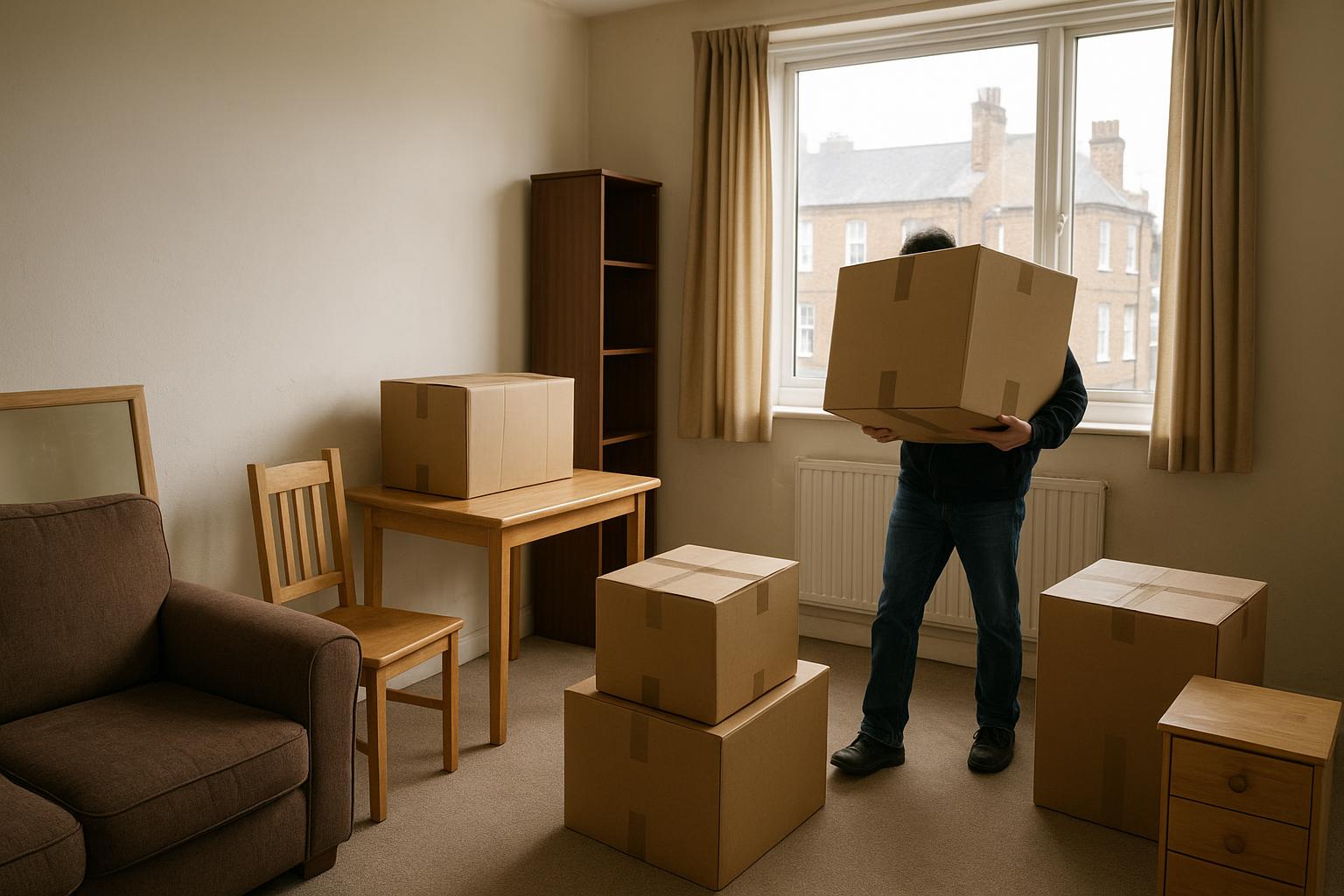
- Photos of every room, plus any cupboards, balcony or storage.
- Floor, lift size and parking details.
- A list of items to keep and anything fragile or valuable.
- Your deadline and any building access hours.
How the process works, start to finish
Three steps from description to collection.
Describe the job
Say what size of flat it is and what must go, roughly how much there is and anything you want to keep.
Add access and timing
Mention the floor, lift, parking and building access hours.
Get a carrier quote
Post the job, compare licensed carriers' quotes and choose, with no obligation to accept.
Frequently asked questions
How much does a 1-bedroom flat clearance cost in London?
Our prices page gives an indicative £240 to £420. The real price is the quote you receive.
How much does a 2-bedroom flat clearance cost?
An indicative £380 to £620 for a 2-bedroom flat or maisonette.
How long does it take?
Typically 45 to 60 minutes of loading for a one-bed and 1 to 1.5 hours for a two-bed.
Does the lift change the price?
Yes. Without a lift, carrying down stairs typically adds about £30 to £60 per flight.
Is VAT included?
It depends on the carrier, since carriers are independent businesses. Any quote shows clearly whether VAT applies.
Can I get paid for valuable items?
Possibly. Some carriers may reduce the quote for items they can resell, but there is no guarantee.
What size of vehicle does a 2-bed flat need?
Our prices page describes a 2-bedroom flat as fitting roughly half a standard 3.5-tonne Luton van, though a heavily furnished flat may need more. The carrier decides based on your photos.
Can I clear just one room of a flat?
Yes. A partial job is priced by volume using the van-load table, from a single-item minimum of £65 to £95 up to larger fractions.
What if I have to book the lift?
Tell the carrier the slot you have reserved when you post. A fixed lift slot means the arrival time needs to match.
Do I need a parking permit?
Not always, but in controlled parking zones a visitor permit or a council suspension may be needed. The prices page notes suspension fees of £35 to £90 per day depending on the borough.
How do I know the carrier is legitimate?
Ask for their waste carrier registration number and check it on the government register. See our guide to choosing a licensed company.
Is the price different in Zone 1 than outer London?
It can be. Parking, access and congestion factors differ across London, so the quote reflects your actual postcode and building.
Ready to see your price?
Post your flat clearance for licensed carriers to quote on.