
Direct answer
Asbestos testing in London typically costs about £80 to £140 per sample, removing a standard asbestos cement garage roof about £600 to £1,500, and disposal of bonded material about £450 to £800 per tonne. Those are indicative ranges, not a rate card. Asbestos is a specialist hazardous waste job for contractors with the right licence or training, and houseclearance.co carriers handle the rest of a clearance once any asbestos has been dealt with separately.
Contents
- What asbestos removal costs in London
- Is it asbestos? Identifying and testing
- Licensed contractors and non-licensed work
- How asbestos waste is disposed of
- Asbestos and house clearance, garage and building work
- Where asbestos is commonly found in London homes
- Low-risk and high-risk asbestos: why the price varies so much
- Worked examples: reading the three indicative figures
- What the rules say, in plain English
- Choosing and checking an asbestos contractor
- If you find suspected asbestos during a clearance
- Practical timing and London considerations
- How to get a sensible price
- Frequently asked questions
What asbestos removal costs in London
Indicative ranges for the common jobs, not a rate card.
Asbestos work is priced very differently from ordinary rubbish removal, because it is a regulated hazardous waste that must be identified, handled with precautions, double-wrapped and taken to a licensed site. The ranges below are indicative figures for common domestic jobs in London. Your own price depends on the material, the amount and whether the work needs a licence.
| Job | Indicative cost | What it depends on |
|---|---|---|
| Sampling and lab test of a suspect material | £80 – £140 | Number of samples, surveyor call-out, lab turnaround |
| Removal of a standard asbestos cement garage roof | £600 – £1,500 | Roof size, access, whether panels are intact, disposal fees |
| Bonded (asbestos cement) material, per tonne | £450 – £800 | Contractor and licence level, quantity, distance to site |
Treat these as planning figures only. Asbestos costs rise quickly if the material is damaged, if it is insulation or coating rather than cement, or if the work has to be enclosed. A contractor should visit, or at least see clear photographs, before giving a price.
Is it asbestos? Identifying and testing
Why you should never guess.
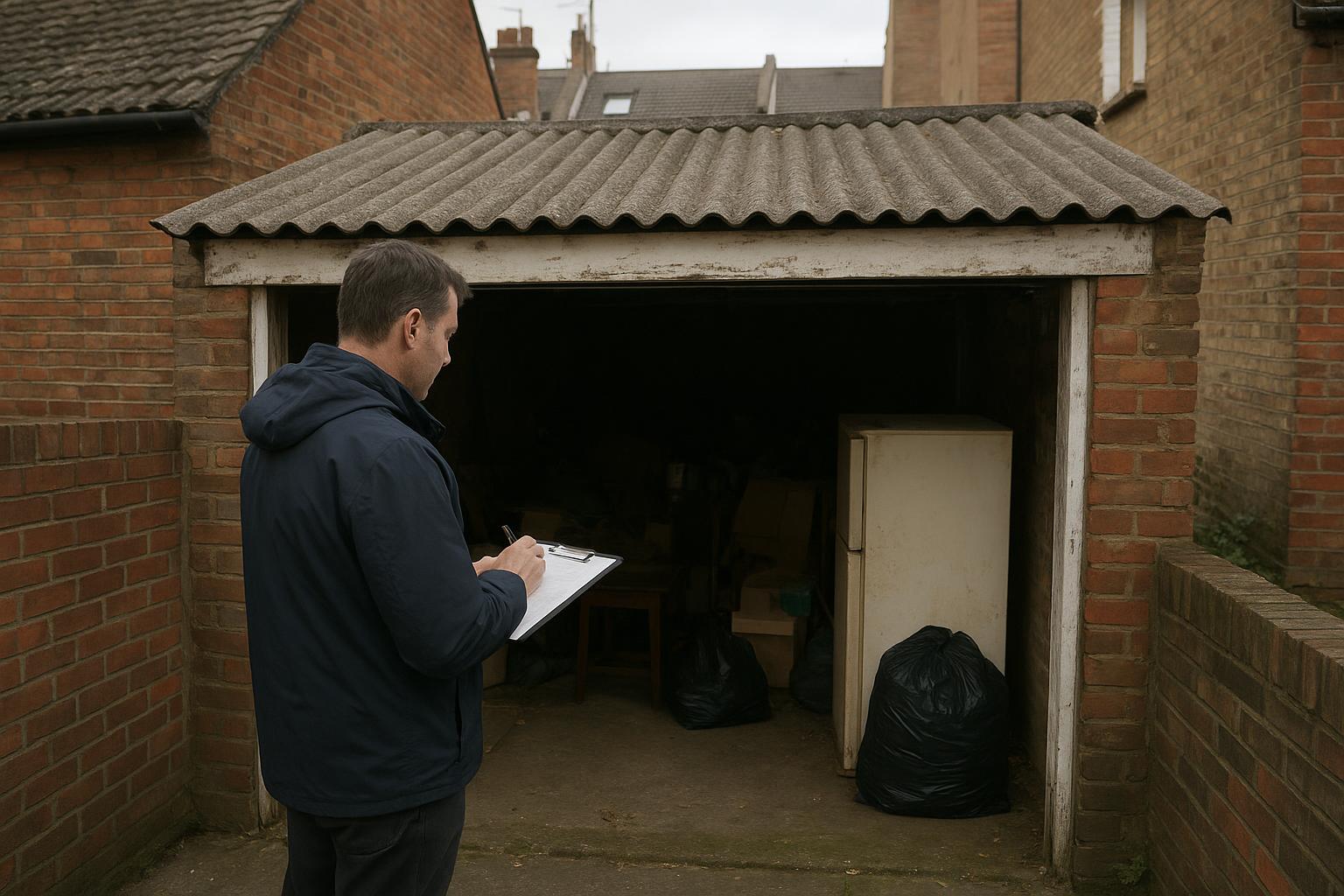
Asbestos was banned from use in the UK in 1999, but it can still be found in homes built or refurbished before then. Common places include garage and shed roofs and panels made of asbestos cement, textured coatings on ceilings, pipe lagging, boiler and flue materials, old floor tiles and the backing of some vinyl flooring. You cannot tell by looking, so a suspect material needs to be tested.
A surveyor or contractor can take a sample and send it to an accredited laboratory, which is what the sampling figure above pays for. Until you have a result, leave the material alone:
- Do not drill, sand, scrape, break or sweep it, and do not use a vacuum cleaner on suspect dust.
- Keep children and pets away and, if it is damaged, keep the room closed.
- Do not put it in a skip or ordinary rubbish, and do not take it to a normal household recycling centre unless the council has confirmed it accepts it.
The Health and Safety Executive publishes plain-English guidance on where asbestos is found and what to do.
Licensed contractors and non-licensed work
Not every asbestos job needs a licence, but none is for a general clearance crew.
In Great Britain, work with the more dangerous forms of asbestos, such as sprayed coatings, lagging and insulation board, generally has to be done by a contractor licensed by the HSE. Lower-risk work, such as removing intact asbestos cement sheets from a garage roof, can fall under non-licensed or notifiable non-licensed work, but it still has legal requirements for training, precautions and notification.
In practice that means you should get quotes from contractors who specialise in asbestos, ask what licence or training they hold, and ask for their waste carrier registration and the paperwork for disposal. A general house clearance or rubbish removal carrier should not be taking asbestos out of a property, and if suspected asbestos turns up during a clearance, work involving it should stop until it has been identified.
How asbestos waste is disposed of
Hazardous waste has its own rules and paperwork.
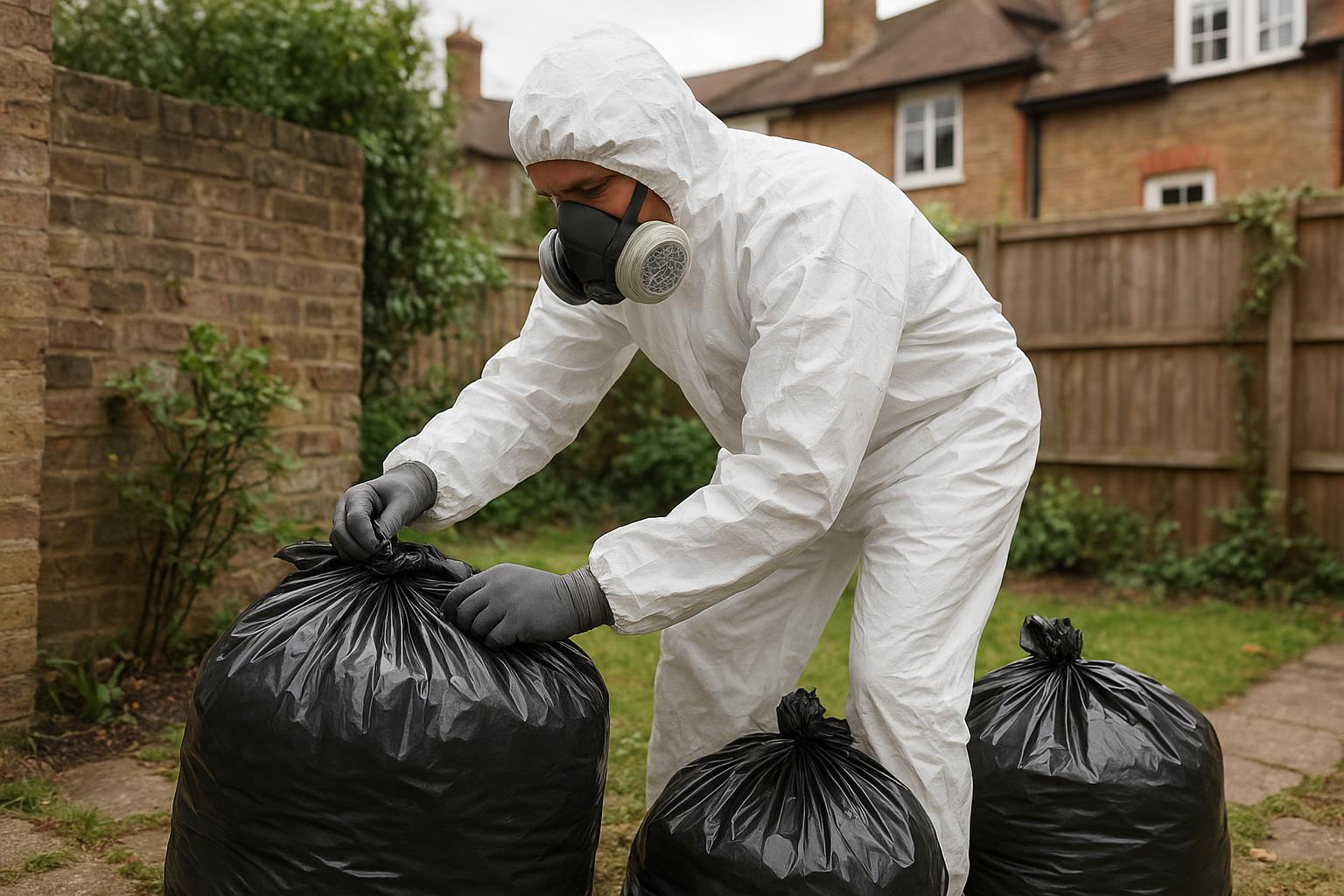
Asbestos waste is classed as hazardous waste. It has to be wrapped and labelled, transported by a registered carrier and taken to a site permitted to accept it, and the movement is recorded on a consignment note. That is a large part of why the cost per tonne is so much higher than for general waste.
Most London household recycling centres do not take asbestos. A few councils accept small quantities of bagged asbestos cement from residents by booking, so check your own council's website before doing anything. Never fly-tip it. Leaving asbestos on a roadside is a serious offence, and as the householder you can be held responsible if you hand it to someone without the right registration. See our guides to fly-tipping penalties and the householder duty of care.
Asbestos and house clearance, garage and building work
Where it comes up in practice.
The places asbestos most often affects a clearance are garages, sheds and lofts, older properties being cleared after a death or sale, and renovation work. If you are clearing a garage with a corrugated cement roof, the roof is a separate specialist job from the contents, and our garage clearance cost guide explains how the contents are priced.
For building and renovation waste more widely, see the builders and renovation waste cost guide and the building waste disposal guide. For a whole property, the house clearance cost guide covers how a normal clearance is priced once any hazardous material has been dealt with separately, and our responsible disposal page explains what happens to ordinary waste afterwards.
Where asbestos is commonly found in London homes
Age of the building matters more than anything else.
London has a very large stock of Victorian, interwar, postwar and 1960s to 1980s housing, and asbestos was widely used in building products until it was banned in the UK in 1999. That does not mean every older home contains it, but it does mean that any material from that period should be treated as suspect until tested. The table lists the places it most often turns up.
| Location | Typical material | Why it matters for cost |
|---|---|---|
| Garage, shed and outbuilding roofs | Corrugated asbestos cement sheets | Usually the cheapest to deal with if intact, which is why the garage roof figure above is the common benchmark. |
| Soffits, fascias and cladding | Flat asbestos cement or insulation board | Quantity and access (ladders, scaffold) drive the price. |
| Textured ceiling and wall coatings | Decorative coatings applied before 2000 | Cannot be scraped or sanded safely. Needs testing and specialist advice before redecorating. |
| Pipe lagging, boiler and flue materials | Insulation, sometimes loose or friable | Higher risk, and often work for a licensed contractor. |
| Floor tiles and backing | Vinyl tiles and bitumen adhesive | Often low risk if undisturbed, but sanding or lifting changes that. |
| Cold water tanks, panels behind radiators | Asbestos cement or board | Found during refurbishment and loft clearances. |
This list is a guide, not a diagnosis. Only laboratory testing of a sample, or a qualified surveyor's assessment, can confirm what a material is. The cost range on this page for sampling (£80 to £140) is small next to the cost of getting it wrong.
Low-risk and high-risk asbestos: why the price varies so much
Condition and type decide the regime, and the regime decides the cost.
Asbestos is not one risk level. Intact asbestos cement sheets are generally considered lower risk than sprayed coatings, lagging or loose insulation, because the fibres are locked in a hard cement matrix. Damage, weathering and drilling change that.
- Intact and undisturbed. Often best left alone and managed, if it is in good condition and out of the way. Removal is not always required.
- Weathered or damaged. Cracked, broken or crumbling material releases more fibres and may need prompt specialist attention.
- Friable or loosely bound. Lagging, sprayed coatings and loose insulation are the most hazardous and are the work of a licensed contractor. Costs are significantly higher because of enclosures, air testing and protective equipment.
- Part of a larger project. Asbestos found during demolition, conversion or a loft clearance can delay a project until it has been surveyed and removed.
This is why the three indicative figures at the top of the page cannot be added together into a total. Each depends on the material and its condition, and a single home may involve a sample, a garage roof and a small quantity of other material at once. The HSE publishes guidance on the different forms and what each means in practice.
Worked examples: reading the three indicative figures
Illustrations built only from the ranges above. They are not real jobs or quotes.
Scenario 1: a suspect textured ceiling before redecorating
You want to skim a textured ceiling in a 1970s flat. The first step is a sample, indicatively £80 to £140 per sample. If the lab says there is no asbestos, you can go ahead. If there is, you need specialist advice, and removal is a separate quote. Nobody should scrape the ceiling in the meantime.
Scenario 2: an intact corrugated garage roof
A standard asbestos cement garage roof in good condition sits in the indicative £600 to £1,500 range for removal. The spread reflects roof size, access, whether panels are intact and disposal fees. Photographs and a surveyor's visit narrow it.
Scenario 3: a pile of broken cement sheets in a back garden
If the contractor charges by weight, the indicative £450 to £800 per tonne for bonded material applies. A tonne is a lot of sheeting, so for a small quantity the per-tonne figure will not describe the real cost, and a minimum charge or per-job price is more likely. Ask how the quote is built.
These scenarios are about structure, not prediction. The real figure comes from contractors who have seen the material or photographs of it.
What the rules say, in plain English
A brief orientation, not legal advice.
In Great Britain, work with asbestos is governed by the Control of Asbestos Regulations 2012, and the Health and Safety Executive is the regulator. For householders, the practical effects are as follows.
- Employers and contractors have duties. Anyone doing asbestos work as a business must follow the regulations, including training, precautions and, for some work, notification to the authorities.
- Licensed work is limited to certain materials. As described above, higher-risk materials generally need an HSE-licensed contractor.
- Householders are not the main duty holders for their own home, but they are responsible for what they hand to others. If you pass hazardous waste to an unregistered carrier and it is dumped, you can be held responsible.
- Landlords and managing agents have wider responsibilities for non-domestic and shared parts of buildings. If you manage a building or landlord property, ask a specialist what applies.
Because the details depend on the situation, rely on the HSE's published guidance and on written advice from a qualified contractor, rather than on a summary like this one. Our householder duty of care guide and fly-tipping penalties guide cover the waste side.
Choosing and checking an asbestos contractor
What to ask for and what to verify.
| Question | Why it matters |
|---|---|
| Do you hold an HSE licence, or training for non-licensed work, and can I see it? | The right credentials depend on the material. Do not accept vague assurances. |
| Will you sample and test first, and through which laboratory? | Testing confirms what you are dealing with and should come before a removal price. |
| Does the price include wrapping, labelling, transport, disposal and paperwork? | Many surprises come from items left out of the first figure. |
| Are you a registered waste carrier, and will I receive a consignment note? | Hazardous waste has its own paperwork. Keep it. |
| How will the area be protected and cleaned afterwards? | A clear method statement shows the contractor takes precautions seriously. |
| Is a clearance certificate or air test included where relevant? | For higher-risk work you may need proof the area is safe to re-occupy. |
| What happens if more asbestos is found? | Understand how extra material is priced before work starts. |
Get at least two written quotes, and be wary of anyone offering to take asbestos away for cash with no paperwork. Our guide to choosing a licensed company and the waste carrier licence check page cover the general checks. houseclearance.co carriers are general waste carriers, and asbestos work should go to specialists.
If you find suspected asbestos during a clearance
A sensible order of operations.
Asbestos often surfaces unexpectedly, when a loft is opened, a shed is emptied or an old boiler cupboard is cleared. A calm sequence helps.
- Stop. Do not move, break or sweep the material. Tell everyone on site, including any carrier already there.
- Isolate. Close the door to the room, keep children and pets out, and turn off fans or heating that could spread dust.
- Photograph. Take clear photos of the material, its location and its condition from a distance.
- Test. Arrange sampling through a surveyor or contractor.
- Plan. Decide whether to leave it in place, encapsulate it or remove it, based on specialist advice.
- Clear the rest after. Post the remaining job once the asbestos is dealt with. See the house clearance cost guide and loft clearance cost guide.
If you are a leaseholder or tenant, tell your landlord or managing agent as well. For garages, sheds and outbuildings, the garage clearance cost guide and shed clearance cost guide explain how the contents are priced separately from the roof or structure.
Practical timing and London considerations
Lead times, access and sequencing.
- Lead times. Sampling and lab results take time, and specialist contractors may have waiting lists. Do not plan a clearance deadline around asbestos work without allowing for it.
- Access. London plots are tight. Garage roofs may be reached only through a side alley, and removal may need ladders, scaffold or protective sheeting over neighbours' boundaries.
- Parking and waste vehicles. A contractor's vehicle and a licensed disposal route need space. If you need a parking suspension, see our prices page, which notes fees of £35 to £90 per day depending on the borough.
- Neighbours. Tell neighbours before work starts, especially where asbestos sheeting is shared or close to a boundary.
- Sequencing. Asbestos work comes first, then the clearance, then any rebuilding. See the builders and renovation waste cost guide and building waste disposal guide.
How to get a sensible price
Three steps from suspicion to removal.
Identify it
Have the material tested. Do not disturb it first.
Get specialist quotes
Ask asbestos contractors for written quotes covering removal, wrapping, transport, disposal and the paperwork, and compare more than one.
Then clear the rest
Once the asbestos is gone, post the remaining clearance and licensed carriers can quote for the rest of the job.
Frequently asked questions
How much does asbestos removal cost in London?
Indicatively, £80 to £140 to test a sample, around £600 to £1,500 to remove a standard asbestos cement garage roof, and £450 to £800 per tonne of bonded material. The real price depends on the material, the amount and whether a licence is needed.
Can I remove asbestos myself?
Do not guess. Some low-risk asbestos cement work is not licensed, but it still carries legal requirements, and the dust is dangerous if disturbed. Get it tested and ask a specialist for advice before touching it.
Will a house clearance company take asbestos?
A general clearance or rubbish removal carrier should not remove asbestos. It is a specialist hazardous waste job, and suspected asbestos found during a clearance should be left until it has been identified.
Can I take asbestos to the council tip?
Most London household recycling centres do not accept it. A few take small bagged amounts of asbestos cement by appointment, so check your council's website first.
How do I know if something contains asbestos?
You cannot tell by looking. Materials in buildings from before 2000 should be treated as suspect until a laboratory test says otherwise.
What happens if I fly-tip asbestos?
It is a serious offence and can lead to prosecution or substantial fines. As the householder you can also be liable if you pass it to someone who is not a registered carrier.
Does every old building have asbestos?
No. Many do not, but you cannot tell by looking. Treat materials from before 2000 as suspect until a laboratory test says otherwise.
Can intact asbestos be left in place?
Often it can if it is in good condition and not going to be disturbed. A specialist can advise whether monitoring or removal is the better route.
How long does an asbestos test take?
It depends on the laboratory and the service chosen. Ask the surveyor or contractor for a likely turnaround when you book the sample.
Do I need to tell my neighbours?
It is good practice, especially for shared roofs, party walls and close boundaries, and a contractor will usually ask.
Who is responsible if my builder finds asbestos?
Ask for a written statement of who handles testing, removal and waste before work starts. Do not let work continue until it has been identified.
Will my insurer cover asbestos removal?
Policies vary and many exclude it. Check your policy wording or ask your insurer, rather than assuming.
Ready to see your price?
Once any asbestos has been dealt with, post the rest of your clearance for licensed carriers to quote on.