
Direct answer
Gas cylinder disposal in London typically costs about £45 to £85 per cylinder, empty or full, with smaller camping canisters often cheaper. That is an indicative range from /prices/, not a fixed rate card, and a licensed carrier quotes the real price. Many refillable bottles belong to their supplier and can be returned for free or for a small fee, so check that first.
Contents
- What gas cylinder disposal costs in London
- Check whether the supplier will take it back
- Why gas cylinders cannot go in the bin
- Preparing a cylinder for collection
- Gas cylinders as part of a bigger clearance
- The kinds of gas cylinder people ask about
- Who owns the bottle? A short checklist before you pay anyone
- Comparing the routes: supplier, council site or licensed carrier
- Worked examples: how to read the indicative range
- Storing and moving a cylinder safely until collection
- London-specific points: flats, parking and council rules
- Questions to ask a carrier before you accept a quote
- Common mistakes with gas cylinders
- Price table: indicative ranges at a glance
- How the process works, start to finish
- Frequently asked questions
What gas cylinder disposal costs in London
Per-cylinder pricing, not a flat rate.
Gas bottles are pressurised and flammable, so they cannot go in a bin or skip and carriers charge to take them to a site that can handle them. Our prices page lists gas canisters and cylinders at an indicative £45 to £85 each, whether empty or full. Smaller cylinders, such as camping canisters, are usually at the lower end or cheaper, and larger domestic cylinders at the higher end.
| Cylinder | Indicative cost |
|---|---|
| Gas canister or cylinder, empty or full (from /prices/) | £45 – £85 each |
| Small camping or helium-type cylinder | Often lower; quoted individually |
| Standard domestic propane or butane bottle | Within the range above, unless it can be returned to its supplier |
These are planning figures, not a fixed rate card. The price depends on the cylinder type and size, how many there are, whether they are full, and whether the cylinder belongs to a supplier who will take it back for free or for a small fee.
Check whether the supplier will take it back
The cheapest route is often not disposal at all.
Many refillable gas bottles remain the property of the supplier, such as the company you buy propane or butane from. These cylinders can usually be returned to the supplier or to an exchange stockist, and you may be able to get a deposit back or simply hand it in. Look for a name or label on the bottle and check the supplier's website before paying anyone to dispose of it.
Disposal charges mainly apply to cylinders you own outright, to cylinders whose supplier cannot be identified, and to cylinders that are damaged or corroded. If the bottle is leaking, smells of gas or is badly damaged, treat it as an emergency, keep away from flames and sparks and follow the guidance of the supplier or the emergency services.
Why gas cylinders cannot go in the bin
Pressure and flammability make them a hazard to handle.
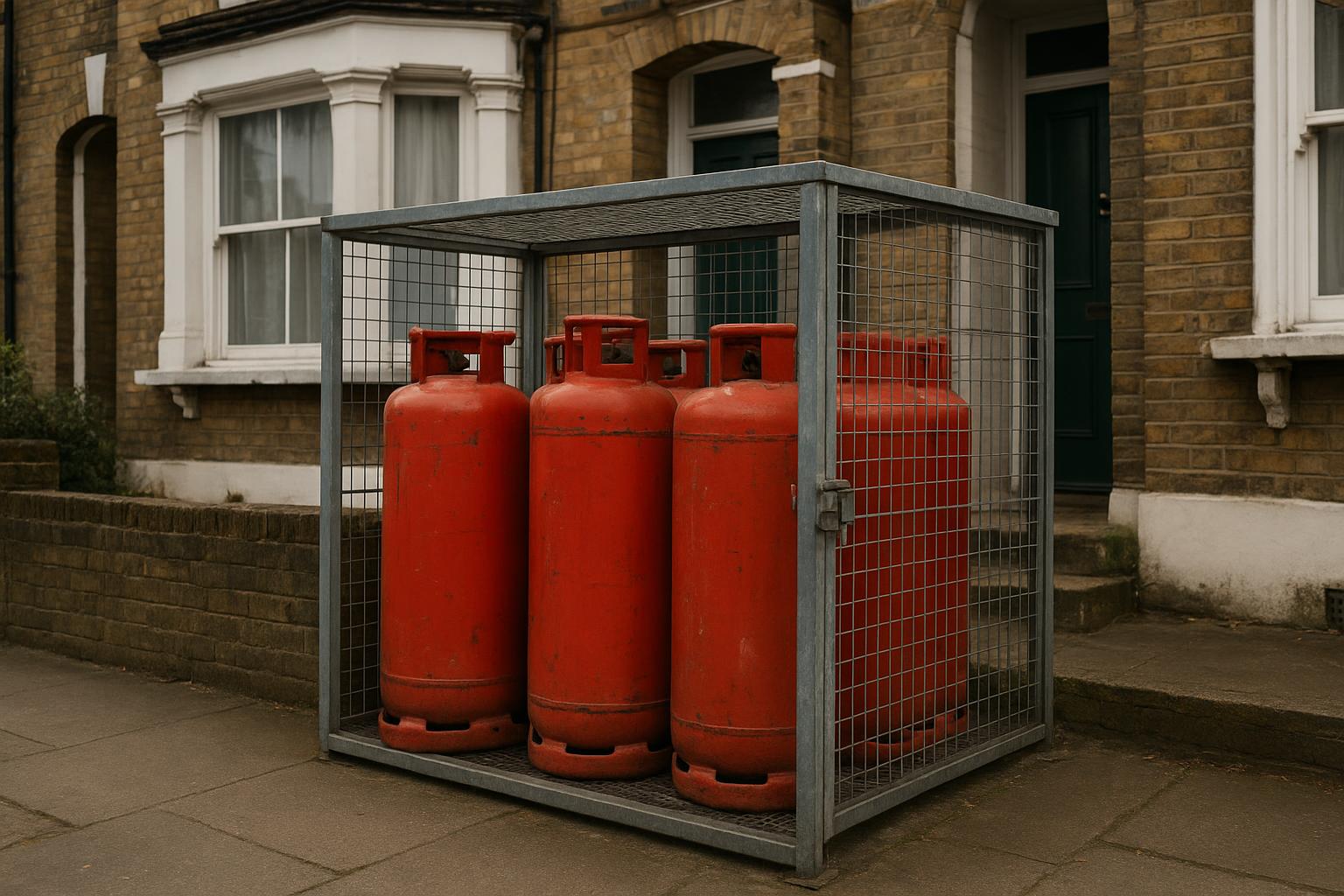
A gas cylinder, even one you believe is empty, can still hold residual gas and pressure. In a bin lorry, skip or compaction unit it can leak, ignite or explode, which puts collection crews at risk. That is why cylinders are always handled separately from general waste.
Disposable camping canisters and similar small cylinders may be accepted at some household recycling centres when completely empty, but rules differ between councils, so check yours. Our tip runs guide explains what to expect at a London site. Never leave a cylinder at the roadside, in someone else's bin or dumped in a park: it is fly-tipping, and the householder who handed it over can be held responsible. See our guides to fly-tipping penalties and the householder duty of care.
Preparing a cylinder for collection
Simple safety steps before the carrier arrives.
Before you post the job
- Count the cylinders and note the size, type and any supplier name on the label.
- Say whether they are empty, partly used or full if you know.
- Mention any damage, rust or leaks.
Until collection
- Close the valve fully and keep the cylinder upright in a well-ventilated outdoor place such as a garden or shed doorway, away from heat, flames and drains.
- Do not try to empty a cylinder, release gas or remove the valve yourself.
- If you have to move one, carry it upright and secure it so it cannot roll, and never leave it in a hot car.
Cylinders are often found in garages, sheds and gardens. The garage clearance preparation guide and the shed clearance preparation guide have wider checklists.
Gas cylinders as part of a bigger clearance
Mention them when you post.
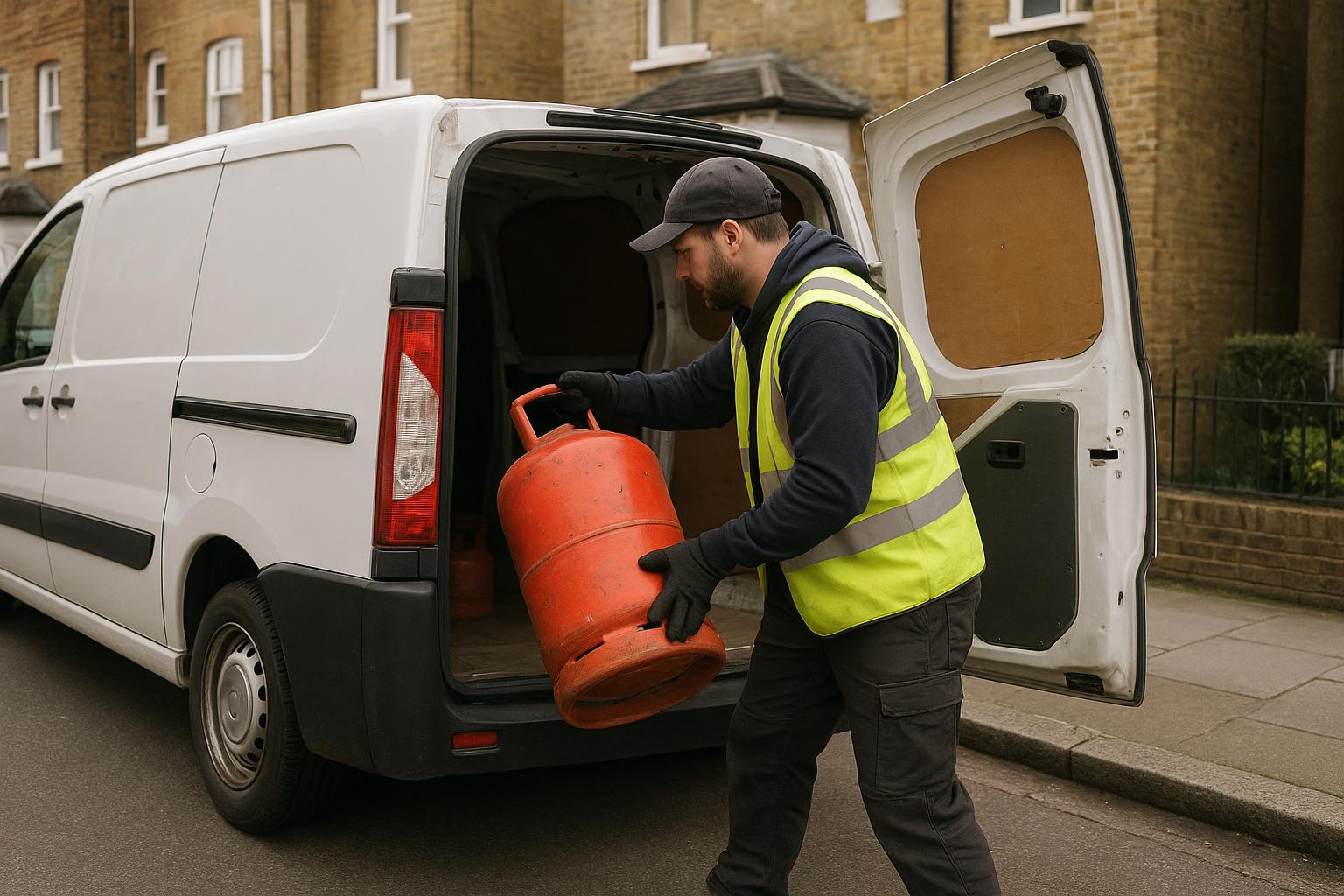
Cylinders turn up in sheds, garages, gardens and in properties cleared after a death or move. If they are going as part of a wider job, list them when you post, because they are handled separately from ordinary waste. See the shed clearance cost guide, the garage clearance cost guide, the garden clearance cost guide and the house clearance cost guide for how those jobs are priced.
Other hazardous household items such as leftover paint are priced separately too. See our paint and liquid waste disposal guide, and the boiler removal guide if the cylinder fed an old heater or boiler.
The kinds of gas cylinder people ask about
Different bottles, different handling, one price range to start from.
Householders use the phrase gas bottle for several quite different things. The indicative figure on our prices page covers gas canisters and cylinders as a group, at £45 to £85 each, but what you actually have decides how a carrier plans the collection. The table below lists the types that come up most often in London homes, gardens and garages.
| Type | Where it is usually found | What to know before you book |
|---|---|---|
| Refillable propane or butane bottle | Patio heaters, barbecues, caravans, garden sheds | Often owned by a supplier and returnable. Look for a name on the collar or label before you pay for disposal. |
| Disposable camping canister | Camping kit, portable stoves, garage shelves | Small and light, but still pressurised. Some recycling centres take completely empty ones, so check first. |
| Helium or party-balloon cylinder | Cupboards and garages after an event | Usually a small disposable cylinder. Do not puncture it, and tell the carrier if it is not completely empty. |
| Hobby or workshop cylinders | Garages, workshops and allotment sheds | Larger and heavier, and sometimes holding gases other than propane. Describe the label and size so the carrier can say whether they can take it. |
| Old or unmarked bottle | Inherited sheds and cleared properties | If the label is gone, corroded or unreadable, say so. The carrier will want photos before quoting. |
If you are not sure what is in a bottle, do not open the valve to find out. Photograph the label, the size and the condition of the valve and base, and include the photos when you post the job. A carrier can then tell you honestly whether the bottle fits within the indicative range or needs separate handling.
Who owns the bottle? A short checklist before you pay anyone
Ownership decides whether the job is a free return or a paid collection.
The single most useful question on this page is who the cylinder belongs to. Many people assume a bottle is theirs because it has been in their shed for years, when in fact it is still the property of the company that supplied the gas. The checklist below takes about five minutes.
- Read the label and collar. Look for a company name, a brand name or a returns telephone number on the body or the collar around the valve.
- Check your old paperwork. A receipt, deposit slip or supplier account may show that the bottle is on loan or that you paid a returnable deposit.
- Look at the supplier's website. Suppliers usually explain how to hand a bottle back, whether through an exchange stockist, a depot or a collection.
- Ask the person you inherited it from, or the landlord. If you are clearing a property, the previous occupant or letting agent may know where the bottle came from.
- Note the condition. A returnable bottle that is rusted, dented or leaking may not be accepted at a counter, in which case a private collection becomes the safer route.
If the supplier takes it back, you may pay nothing or a small fee, which beats any disposal charge. If you cannot find an owner, or the bottle is yours outright, that is when a licensed carrier's quote makes sense. Our householder duty of care guide explains why you should still check the registration of whoever takes it.
Comparing the routes: supplier, council site or licensed carrier
Cost, convenience and safety side by side.
| Route | Typical cost | Best when | Watch out for |
|---|---|---|---|
| Return to supplier or exchange stockist | Free, or a small fee, sometimes a deposit back | The bottle has a supplier name and is in sound condition | Damaged or corroded bottles may be refused, and you have to transport it yourself. |
| Household recycling centre | Often free for small empty canisters, but rules differ by council | You have a few completely empty disposable canisters and a car | Many sites refuse larger or full cylinders. Check the rules and any proof-of-address or booking requirement first. |
| Licensed carrier collection | Indicatively £45 to £85 per cylinder from our prices page | Bottles are yours, unmarked, full, damaged, or you cannot transport them safely | Ask how they will be handled and where they will go. Compare more than one quote. |
For a first-time reader the order of preference is simple. Try the supplier first, because it costs least. If that fails, look at your council or local recycling centre for small empty canisters. Our tip runs guide covers what to expect at a London site, and the borough guides for Hounslow and Harrow show how local rules can vary. Use a licensed carrier when the first two do not apply or when moving the bottle yourself would be unsafe.
Worked examples: how to read the indicative range
Planning arithmetic using the published figures. These are illustrations, not real jobs or quotes.
The scenarios below are illustrations built only from the indicative ranges on this page and on our prices page. They are not reports of real customer jobs, and a carrier's actual quote may sit outside them.
Scenario 1: one old propane bottle with a supplier name on it
The label shows a gas supplier and a returns number. The sensible first step is to contact the supplier and ask about return or exchange. If they accept it, the cost may be nothing or a small fee, and no carrier is needed at all.
Scenario 2: two unlabelled bottles from a cleared shed
With no supplier and no way to identify the owner, a carrier collection is the realistic route. At the indicative £45 to £85 each, two bottles would be roughly £90 to £170 before any minimum charge, access difficulty or other items. Posting both together, with photographs, lets the carrier quote once rather than twice.
Scenario 3: a few cylinders inside a bigger garage clear-out
Here the cylinders are one line in a larger job. They are still listed separately because they are handled separately from ordinary waste, but the travel and loading time is shared with the rest of the clearance. See the garage clearance cost guide for how the rest of the job is priced.
In every scenario the lesson is the same: ownership, number, size and condition drive the figure, and clear photographs reduce the chance of the price changing once the carrier arrives.
Storing and moving a cylinder safely until collection
Practical safety, in the order you will need it.
A collection may be a few days away, and a cylinder in the wrong place is a real hazard. The advice below is general safety practice, not a substitute for the supplier's own instructions on the label.
- Keep it outside if you can. A shed doorway, garden or yard with good airflow is better than a cupboard, cellar or under-stairs space. Propane and butane vapour can collect at low levels if there is a leak.
- Keep it upright and stable. Stand it on a flat base where it cannot be knocked over, and away from drains and basement stairwells.
- Keep it cool. Heat raises the pressure inside a cylinder. Store it away from radiators, direct sun, barbecues, boilers and anything that sparks.
- Do not tamper. Never try to empty a cylinder, force a valve, unscrew a regulator while there is pressure, or cut a bottle open.
- Keep it out of the car boot. A cylinder rolling around in a hot car is a risk to you. If you must transport one, secure it upright with ventilation, and drive straight there.
- If you smell gas, do not use switches or naked flames, open windows if it is safe to do so, leave the area and follow the advice of the supplier or the emergency services.
For a property with a number of garage or shed items to deal with, the garage clearance preparation guide and shed clearance preparation guide cover the wider tidy-up so that the cylinders are the only awkward items left on the day.
London-specific points: flats, parking and council rules
Where the capital differs from a typical house with a garden.
London homes make cylinders more awkward than the average UK house. Many people live in flats with no garden or shed, and a bottle that came with a balcony heater or a camping trip may be sitting in a hallway cupboard.
- Flats and shared buildings. Check your lease or tenancy for rules on storing gas cylinders, and ask your managing agent. Some buildings restrict them, and a bottle should not be kept in shared corridors or stairwells.
- Stairs and lifts. A cylinder is heavy for its size. Our prices page lists carrying down stairs without a lift at an indicative £30 to £60 per flight, so say which floor you are on when you post.
- Parking and charges. Our prices page also notes a Congestion Charge allowance of £18 where it applies and parking-suspension fees of £35 to £90 per day in some boroughs. For a single cylinder collection these usually matter less than for a full clearance, but mention your address so the carrier can plan.
- Council rules. Each London borough sets its own recycling centre and bulky-waste rules, and they change. Always check the current council website rather than relying on an old guide, including ours.
- Landlords and tenants. If you are a landlord clearing a flat, the end of tenancy clearance cost guide covers how a tenancy-end clear is priced, and any cylinders should be flagged in the job post.
For wider coverage of the capital, see our furniture collection and disposal guide and the general guide to arranging rubbish clearance in London.
Questions to ask a carrier before you accept a quote
A short list that separates a careful quote from a vague one.
- Does the quote cover every cylinder I have listed, or is it per cylinder with a minimum?
- Is the price the same whether the cylinders are full, partly used or empty?
- Where will the cylinders be taken, and can you tell me the type of site?
- Can you give me your waste carrier registration number, and will you provide a waste transfer note? Our waste transfer notes guide explains the paperwork.
- Is there a minimum charge, or any extra for stairs, parking or short notice?
- Will you handle a damaged, rusted or leaking cylinder, or should I contact the supplier first?
A carrier who answers these clearly is easier to trust than one who gives a very low number and no detail. The guide to choosing a licensed clearance company and our waste carrier licence check page explain what you can verify yourself before booking. Remember that houseclearance.co is a platform that shares your job with independent carriers: it is the carrier who sets the price and does the work.
Common mistakes with gas cylinders
Five ways people create cost, risk or liability.
- Putting a cylinder in the bin or skip. Even a bottle you believe is empty can hold residual gas, and a bin lorry or skip is the worst place for it.
- Leaving it outside a recycling centre or on the roadside. That is fly-tipping. See the fly-tipping penalties guide.
- Paying disposal charges for a returnable bottle. A five-minute check of the label could have saved the fee.
- Hiding a cylinder in a general clearance quote. If it is not mentioned, the carrier may have to rework the price or leave it behind on the day.
- Handing it to an unregistered collector. A very cheap offer from an unlicensed person is how waste ends up dumped, and the householder can be held responsible.
Price table: indicative ranges at a glance
Indicative London ranges excluding VAT, taken from the houseclearance.co prices page.
The table below sets out the published ranges from our prices page that are most relevant to gas cylinders. Your real price is whatever a licensed carrier quotes after you describe the cylinders.
| Item or collection size | Indicative London range (excl. VAT) |
|---|---|
| Gas canister or cylinder, empty or full (per cylinder) | £45 – £85 |
| Single item minimum charge | £65 – £95 |
| 1/8 van load | £95 – £135 |
| 1/4 van load | £145 – £195 |
Where a cylinder is collected as part of a wider clearance, carriers may price the cylinder as a separate line or fold it into the load, so ask how it has been counted. Flag every cylinder in your job post.
How the process works, start to finish
Three steps from description to collection.
Describe the job
List the cylinders, their type and size, whether full or empty, and where they are.
Add access and timing
Mention parking, stairs and your preferred day.
Get a carrier quote
Licensed carriers quote against the real scope. Compare the offers and choose, with no obligation to accept. Ask how the cylinders will be handled and where they will go.
Frequently asked questions
How much does it cost to dispose of a gas bottle in London?
Indicatively £45 to £85 each, empty or full, according to our prices page, with small camping cylinders often cheaper. The real price is the quote you receive.
Can I put an empty gas bottle in the bin?
No. Even an empty cylinder can hold residual gas and pressure and must be handled separately from general waste.
Can I return a gas bottle to the supplier?
Many refillable bottles belong to the supplier and can be returned to them or an exchange stockist, sometimes with a deposit back. Check the label and the supplier's website first.
Will the council tip take gas cylinders?
Some recycling centres take completely empty small canisters, but rules differ. Check your council's website before you go.
What should I do with a leaking or damaged cylinder?
Treat it as a safety issue. Keep away from flames and sparks, ventilate the area, and follow the supplier's or emergency services' advice before arranging disposal.
Is it safe to transport a gas bottle in my car?
Keep it upright, secured and ventilated, and never leave it in a hot car. For larger or damaged cylinders, it is safer to have a licensed carrier collect it.
What kinds of gas cylinder can a carrier collect?
That depends on the carrier and the cylinder. Domestic propane and butane bottles and small canisters are the common cases. For larger, unmarked or hobby cylinders, describe the label and size with photos when you post so the carrier can confirm.
Is it cheaper to take cylinders to the supplier than to book a carrier?
Usually yes, if the bottle is returnable. A return or exchange may cost nothing or a small fee, whereas a carrier collection is indicatively £45 to £85 per cylinder on our prices page.
Do I have to be at home for the collection?
Most carriers want someone present or a clear arrangement for access, particularly for a safety-sensitive item. Agree this when you accept the quote.
Can several cylinders be collected in one visit?
Yes. Post them together with sizes and types, because travel and handling time is shared and the carrier can quote the whole job once.
How should I describe a cylinder I cannot identify?
Photograph the label, the valve, the base and the overall size, and describe any rust, dents or smells. Do not try to open or test the valve.
What if I am clearing a property and find cylinders I did not expect?
Leave them where they are if they appear sound, keep them upright and away from heat, and list them with the rest of the job. See the house clearance cost guide for how the wider job is priced.
Ready to see your price?
Post your gas cylinder and waste collection job for licensed carriers to quote on.