
Direct answer
Rubbish removal in London typically works out at about £45 to £65 per cubic metre for a larger mixed load, or roughly £3.50 to £6 per bin bag, with small jobs costing more per unit because of minimum charges. Those are indicative figures built from the van-load ranges on /prices/, not a fixed rate card, and a licensed carrier quotes the real price for your waste.
Contents
- What rubbish removal costs per cubic metre and per bag
- Volume, weight and what changes the price
- Per bag, per load or per hour
- Rubbish removal vs skip hire vs the tip
- How much a van load really holds
- Worked examples: estimating your own job
- When weight, not volume, sets the price
- Items that carry their own charge
- London factors that move a volume quote
- What typical jobs look like by situation
- How to estimate your volume before you post
- Comparing quotes fairly
- Waste carrier registration and paperwork
- Sensible ways to reduce the bill
- How to get a sensible quote
- Frequently asked questions
What rubbish removal costs per cubic metre and per bag
Built from the van-load ranges on our prices page.
Most London rubbish removal is priced by volume, meaning how much of the van your waste fills, rather than by weight. Our prices page publishes indicative ranges by van load, and the table below shows them next to the equivalent in cubic metres and black bin bags, which is how many people think about a job.
| Load | Volume | Equivalent bin bags | Indicative price |
|---|---|---|---|
| Single item minimum charge | 1 – 2 cu yd (about 0.8 – 1.5 m³) | 10 – 15 | £65 – £95 |
| 1/8 van load | 2 cu yd (about 1.5 m³) | 20 | £95 – £135 |
| 1/4 van load | 4 cu yd (about 3.1 m³) | 30 – 40 | £145 – £195 |
| 1/2 van load | 8 cu yd (about 6.1 m³) | 70 – 80 | £275 – £345 |
| 3/4 van load | 12 cu yd (about 9.2 m³) | 110 – 120 | £425 – £495 |
| Full van load | 16 cu yd (about 12.2 m³) | 150 – 160 | £575 – £695 |
Converting those ranges, a larger load works out at roughly £45 to £65 per cubic metre, with smaller loads costing more per cubic metre because the minimum collection and travel time is spread over less waste. Per bin bag, a larger load is typically around £4 to £6 per bag, and a very small job often has a minimum of around ten bags or a minimum charge. These are planning figures, not a rate card: the quote you receive is what counts.
Volume, weight and what changes the price
Light household rubbish and heavy waste are priced differently.
For ordinary household rubbish, furniture and clutter, volume is what counts. The ranges above assume mixed light waste. Heavy material such as soil, bricks, rubble, concrete, tiles and plasterboard fills a van quickly in weight terms, and carriers often price it by weight or limit how much can go in a load. Our bricks and rubble guide, topsoil guide and building waste guide cover heavy waste.
- Waste type. Light bagged rubbish is cheapest per cubic metre. Heavy or mixed building waste costs more.
- Access. Stairs, a long carry and no parking increase the labour time and so the quote.
- Special items. Mattresses, fridges, TVs and paint carry their own disposal charges. See our mattress guide and white goods guide.
- Loading from inside or outside. Waste already outside at the kerb is quicker to load than waste carried out of an upstairs flat.
- Minimum charge. A small load often costs about the same as the minimum, because the call-out and disposal fee are fixed.
Per bag, per load or per hour
Three ways rubbish removal is quoted.
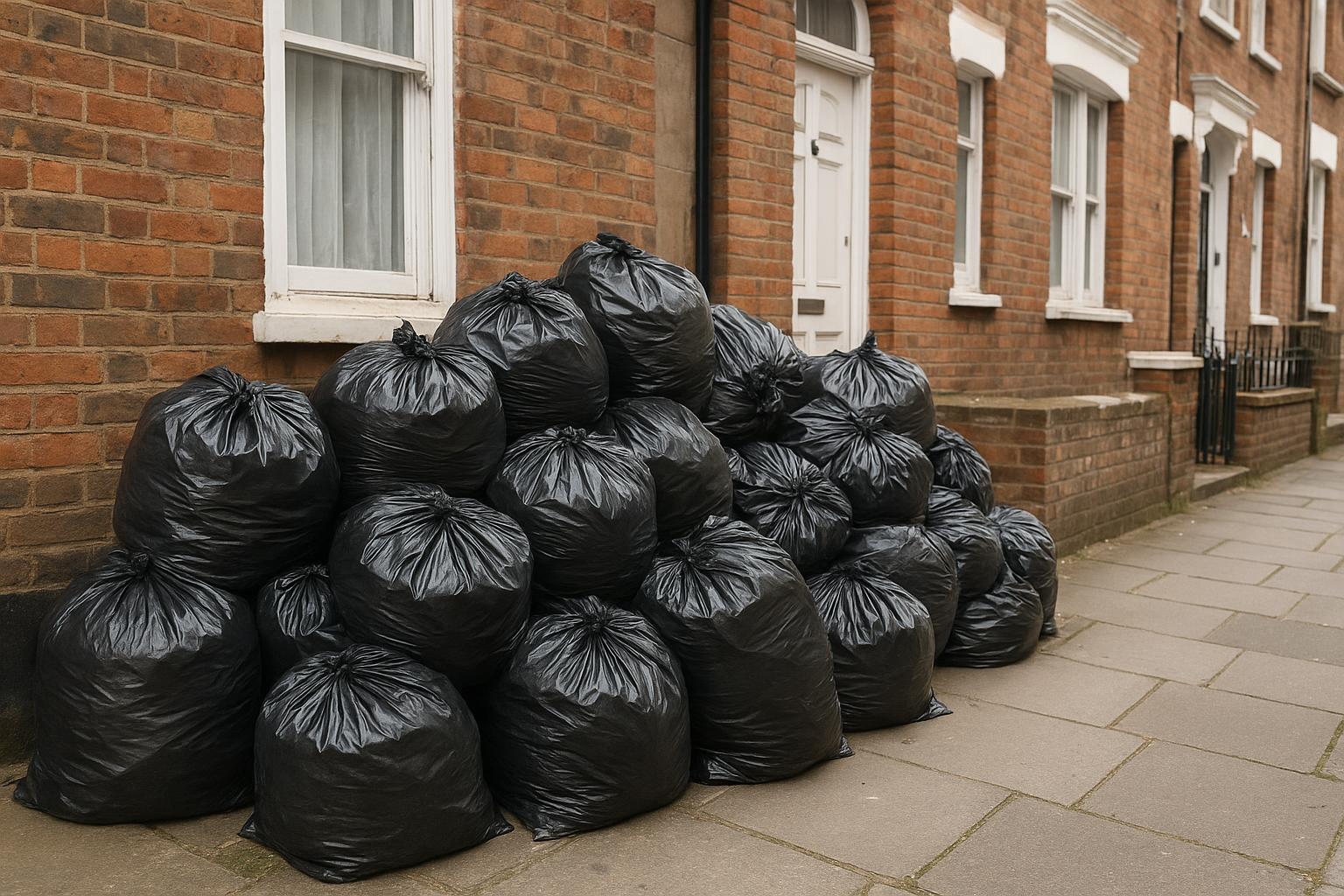
Carriers quote in different ways, which can make quotes hard to compare. Per bag works for a small, tidy job where you can count the bags. By van load is the most common for clearances and mixed waste. Hourly is more common for man and van services where labour is the main cost. When you compare quotes, ask what volume each one covers, whether disposal is included, and whether there is a minimum charge. For hourly services, see how much a man and van costs in London.
Bags also have a practical limit: overfilled or very heavy bags are harder to carry and may not be counted as one bag. Our skip bags guide compares skip bags, skips and man and van costs.
Rubbish removal vs skip hire vs the tip
When per-volume pricing is the better option.
For a small to medium load you do not need to fill, rubbish removal priced by volume is usually simpler than hiring a skip, because you only pay for what you use and the crew loads it. A skip makes more sense when you will fill it over several days and have space and, if needed, a permit. See our house clearance vs skip hire guide and the skip hire cost guide. Taking waste to the tip yourself is cheapest but depends on a vehicle, time and the site's rules: see the tip runs guide.
For a whole property, the house clearance cost guide and pricing by volume guide explain how larger jobs are priced, and the junk removal service covers general rubbish collection.
How much a van load really holds
Cubic yards, cubic metres and bin bags side by side.
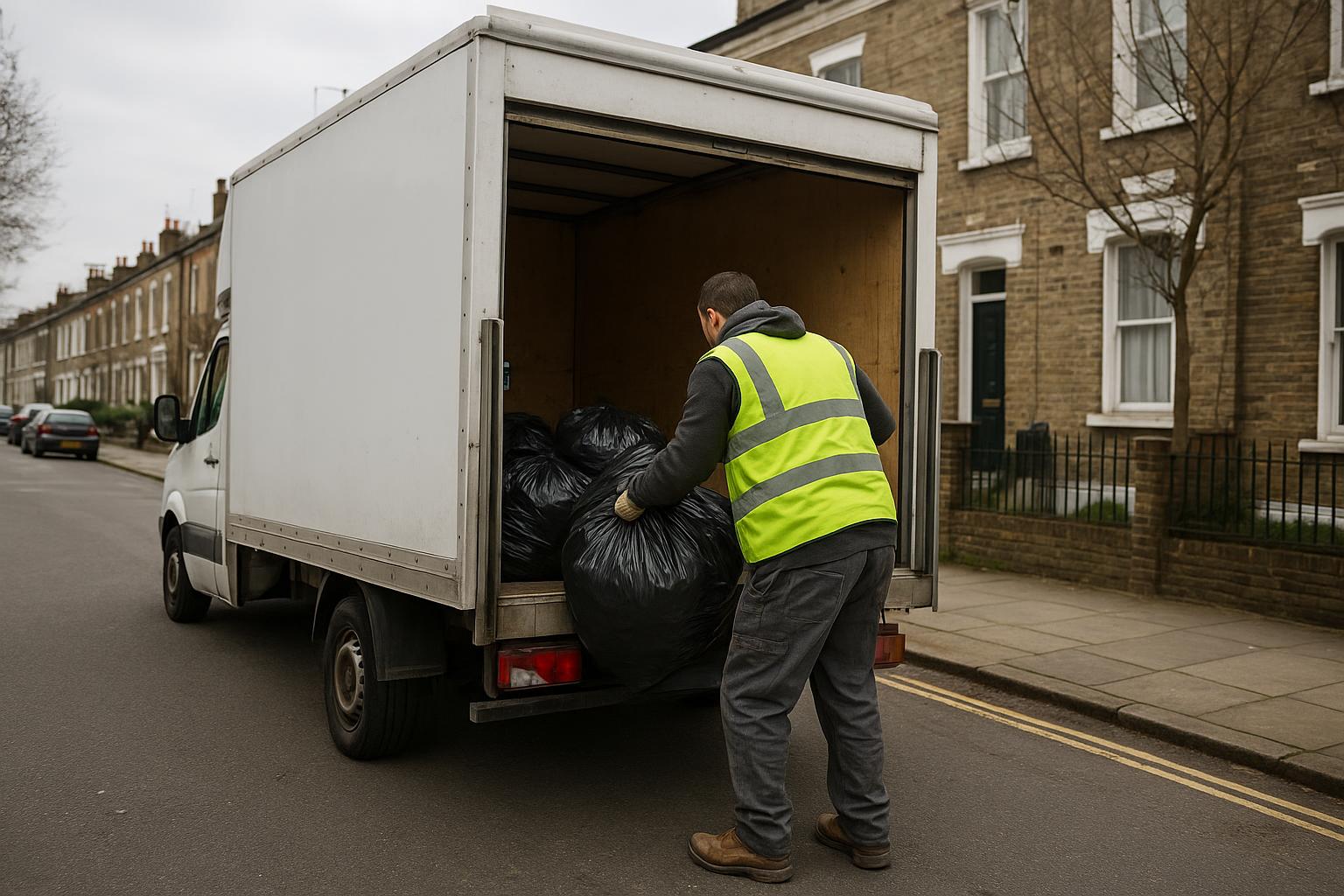
The numbers on our prices page are built around a standard 3.5 tonne Luton van with roughly 16 cubic yards of internal capacity. A cubic yard is a little under three quarters of a cubic metre (about 0.76 m³), so a full van is roughly 12 cubic metres. That is a useful anchor when a carrier talks in cubic metres and you are thinking in van loads or bags.
Bag counts are less precise than they sound. The prices page shows about 150 to 160 standard black bags for a full van, assuming evenly filled bags of light material. Bags packed with books or damp garden waste weigh far more, and loose awkward items such as bed frames, wardrobes and mattresses waste space around them. A carrier is therefore estimating how much of the van your rubbish will use, not simply counting bags.
| Unit | Approximate equivalent |
|---|---|
| 1 cubic yard | About 0.76 cubic metres |
| 1 cubic metre | About 1.3 cubic yards |
| 1/4 van load | About 4 cubic yards (about 3 m³), 30 – 40 bags per our prices page |
| 1/2 van load | About 8 cubic yards (about 6 m³), 70 – 80 bags |
| Full van load | About 16 cubic yards (about 12 m³), 150 – 160 bags |
Worked examples: estimating your own job
Illustrative arithmetic, not real jobs or quotes.
These examples show how to use the table and conversion figures to build a rough budget before you collect quotes.
Example 1: 20 bags from a flat clear-out
Twenty bags is the 1/8 van load row on our prices page, indicatively £95 to £135. Divided by 20 bags, that is about £4.75 to £6.75 per bag, which shows why small loads cost more per bag than the roughly £4 to £6 for bigger loads. If the bags are in the hallway at ground level, there is no stair charge. If they are on the third floor with no lift, our prices page suggests £30 to £60 per flight may be added, which could add £90 to £180 across three flights.
Example 2: a garage with 6 cubic metres of mixed rubbish
Six cubic metres is about 8 cubic yards, the half van row, indicatively £275 to £345. That works out at about £46 to £58 per cubic metre, consistent with the per-cubic-metre range in this guide. If some of it is heavy, such as bricks or old paving, the weight table on our prices page applies instead, with inert builders waste listed at £180 to £260 per tonne.
Example 3: a full van of household clutter
A full van is roughly 12 cubic metres, indicatively £575 to £695 on our prices page, which is about £48 to £58 per cubic metre or £3.60 to £4.60 per bag if there are 150 bags. A mattress, fridge or sofa in that load would have its own disposal charge on top, so list them.
The calculations above are for orientation only. A carrier's actual quote reflects the access, timing and contents of your job.
When weight, not volume, sets the price
Heavy waste per tonne from our prices page.
Most of this guide assumes light mixed waste. Heavy material is different, because a van reaches its legal weight limit long before it looks full. Our prices page publishes indicative figures by weight for dense waste, which carriers use instead of the van-load table.
| Material | Unit | Indicative price |
|---|---|---|
| Inert builders waste (brick, concrete, stone) | Per tonne | £180 – £260 |
| Soil, clean earth or clay | Per tonne | £190 – £280 |
| Plasterboard or gypsum products | Per tonne | £240 – £360 |
| Mixed construction or renovation waste | Per tonne | £220 – £320 |
| Green garden waste | Per tonne or volume | £140 – £220 |
If you are unsure whether a load is light or heavy, lift a bag. Bags of rubble or soil are not suitable for a one-person carry and should be described honestly in your post. Mixed loads, such as a skip-sized clear-out with some rubble in it, are normally split into a volume part and a weight part by the carrier.
Items that carry their own charge
Why a mattress or fridge changes the total.
Some items cannot go with ordinary rubbish and carry a regulated disposal charge, which carriers add to the volume price. Our prices page lists, for example, a single mattress at £25 to £40, a double or king mattress at £45 to £65, an under-counter fridge or freezer at £45 to £70, a washing machine, dryer or dishwasher at £30 to £50 and a flat screen TV under 40 inches at £15 to £25. Paint, gas cylinders and tyres have their own figures too.
In a per-bag or per-cubic-metre quote, ask whether these items are included. If they are not, add them to your estimate. See our guides to mattresses, fridge freezers and hazardous household waste for the detail.
London factors that move a volume quote
Access and location matter as much as the load.
- Stairs and lifts. Our prices page notes that carrying down stairs without a lift typically adds about £30 to £60 per flight.
- Parking. Where a vehicle cannot park near the door, carrying time rises. Where a parking suspension is needed, our prices page indicates a range of £35 to £90 a day depending on the borough. See our controlled parking zones guide.
- Congestion Charge. The standard TfL charge is £18 per day where it applies. Whether it applies depends on the vehicle, route and timing, so ask carriers what they have included.
- Distance to the disposal site. Carriers decide where to take waste and their travel cost feeds into quotes.
- Time slot. Weekday daytime access may differ from evenings or weekends, particularly in blocks with building rules.
Because the same load can be priced differently in different parts of London, the figures in this guide are best used as a sense-check. The real number is the quote you receive for your postcode. Our coverage map shows where carriers on the platform work.
What typical jobs look like by situation
How the same figures apply in a flat, a house and a business.
Flats. In a flat, rubbish is usually a few dozen bags plus a handful of items, so the small-load rows of the table are the relevant ones, and stairs and parking are the main variables. Posting a clear count and the floor level helps carriers quote without a visit. See our flat clearance cost guide if the whole flat is being emptied.
Houses and gardens. A house clear-out or garden tidy often fills a half or full van and may include heavy or green waste, which our prices page prices differently from ordinary rubbish. Garden waste is listed at £140 to £220 per tonne or by volume. See our garden clearance cost guide.
Small businesses. Shops, cafes and offices produce commercial waste, where the producer has a duty of care and should receive paperwork. See the commercial and retail clearance cost guide.
Renovation waste. Builders waste is normally heavy and mixed, and is the main case where the weight table replaces the van-load table. See the building waste guide.
How to estimate your volume before you post
Three methods that work.
- Count the bags. Fill them evenly and count them. For loose items, count them separately and describe the larger ones.
- Use the van comparison. Picture a Luton van. Would your waste fill a quarter, a half or the whole of the load space? Our prices page uses these fractions, so they map to the table.
- Photograph the pile. Take one wide photo of each area with something familiar in frame for scale, such as a door, and add close-ups of anything heavy, hazardous or regulated.
It is better to slightly overestimate and be pleasantly surprised than to understate the job. If the real load is much larger than described, the price may change on the day. Our bulky item preparation guide and the pricing by volume guide give further tips.
Comparing quotes fairly
Per-bag, per-load and hourly prices are not directly comparable.
When quotes arrive in different forms, convert them to the same basis. A per-load price should state the volume it covers. A per-bag price should say the maximum bag size and whether heavy bags count extra. An hourly price needs an estimate of how long the job will take, which depends on the crew size, the access and how much has to be carried. Our man and van cost guide shows how hourly pricing works.
- Does the price include disposal and any regulated item charges?
- Is there a minimum charge or a maximum volume?
- Is loading from inside the property included?
- Is the carrier a registered waste carrier, and will they give you paperwork?
- What happens if there is more waste than described?
You are not obliged to accept any quote. Our guide to choosing a licensed clearance company sets out what to check.
Waste carrier registration and paperwork
Choosing who takes your rubbish matters.
If rubbish you handed over is fly-tipped, you can be held responsible for it as the person who produced it. That is why it matters to use a registered waste carrier and keep the paperwork. Our waste carrier licence page explains what the platform checks before a carrier can quote, and the householder duty of care guide sets out your responsibilities. A suspiciously low price can be a warning sign, so compare the quotes you receive.
Sensible ways to reduce the bill
Practical steps that do not cut corners.
- Move waste to ground level or the kerb before the crew arrives, if it is safe and permitted.
- Separate things you can sell, donate or take back, which reduces the volume. See the furniture donation guide.
- Group everything into a single visit rather than several small ones, since fixed call-out costs are shared.
- Flag heavy and regulated items honestly so the quote is accurate.
- Post early and compare several quotes rather than accepting the first.
How to get a sensible quote
Three steps from estimate to collection.
Estimate the volume
Count the bags or compare against a van: a quarter van, half van or full van. Photographs help carriers quote accurately.
List special items and access
Mention mattresses, appliances, paint, heavy waste, stairs and parking.
Compare quotes
Post the job, compare licensed carriers' quotes and ask what each covers, with no obligation to accept.
Frequently asked questions
How much does rubbish removal cost per cubic metre in London?
Indicatively around £45 to £65 per cubic metre for larger mixed loads, and more per cubic metre for small loads because of minimum charges. The real price is the quote you receive.
How much per bag does rubbish removal cost?
Roughly £3.50 to £6 per bin bag for a larger load, with small jobs often subject to a minimum of around ten bags or a minimum charge.
How many bin bags fit in a van?
Our price table shows about 150 to 160 bags for a full van load, though heavy or awkward items reduce that.
Is rubbish removal priced by weight or volume?
Mostly by volume for ordinary household waste. Heavy waste such as rubble or soil is often priced by weight or limited per load.
Why is a small load more expensive per bag or cubic metre?
Because the call-out, travel and disposal fee are fixed costs spread over less waste.
Is rubbish removal cheaper than hiring a skip?
For small or medium loads usually yes, because you pay only for the volume removed and the crew loads it. A skip can be better for a large, slow clear-out.
How many cubic metres is a full van load?
A standard 3.5 tonne Luton van holds about 16 cubic yards, which is roughly 12 cubic metres.
What is a cubic yard in cubic metres?
One cubic yard is about 0.76 cubic metres.
Can I get a price per bag for heavy rubbish?
Heavy waste such as rubble and soil is normally priced by weight rather than per bag. Our prices page lists per tonne figures for these materials.
Do fridges and mattresses count as bags?
No. They are regulated items with their own disposal charges, which our prices page lists separately, and they should be listed in your post.
Is a minimum charge normal?
Yes. A small load often costs close to the single-item minimum because the call-out and disposal costs are fixed.
Do stairs change a per-cubic-metre price?
They can. Our prices page notes that carrying down stairs without a lift typically adds about £30 to £60 per flight.
Ready to see your price?
Post your rubbish removal job for licensed carriers to quote on.