
Direct answer
Removing and disposing of an upright piano in London typically costs about £150 to £250 from the ground floor and £250 to £450 or more from an upper floor by stairs. Those are indicative planning ranges, not a published rate card: a licensed carrier quotes the real price for your piano, route and access.
Contents
- What piano removal and disposal costs in London
- Worked examples: how a piano job can add up
- Types of piano and why they are priced differently
- What moves the price up or down
- Why pianos are hard to move
- Floors, stairs and London buildings
- Your options: sell, donate or scrap
- Does your piano have any value?
- What happens to a piano that is scrapped
- Decision guide: keep, give, sell or scrap
- How to prepare for a piano collection
- What to check when you compare piano quotes
- Your legal responsibility
- What happens on the day
- Permissions in flats and managed buildings
- How the process works, start to finish
- Other heavy and awkward items in the same job
- Frequently asked questions
What piano removal and disposal costs in London
Indicative ranges, not a rate card: the final figure is always a carrier quote.
A piano is one of the heaviest single items a clearance carrier handles, so price depends mostly on the floor it is on and the route out. Our prices page does not list pianos separately, so the figures below are indicative planning ranges for an upright piano in London rather than published carrier rates.
| Situation | Indicative cost | Notes |
|---|---|---|
| Upright piano from the ground floor | £150 – £250 | Clear route, vehicle close to the door |
| Upright piano from an upper floor by stairs | £250 – £450+ | Needs a bigger crew and specialist handling equipment |
Grand pianos are a different, specialist job and are priced individually. Treat these figures as a starting point only.
Worked examples: how a piano job can add up
Illustrative scenarios built from the indicative ranges above, not real customer jobs.
Because our prices page does not list pianos separately, the scenarios below rely only on the indicative planning ranges in this guide. They are not records of real jobs and a carrier's quote may be higher or lower.
Scenario 1: an upright piano in a ground-floor room with a clear route
The planning range is £150 to £250. That assumes the van can park close to the door, there are no steps or only a single threshold, and the route is wide enough. If the piano is in a hallway beside the front door, it may fall at the lower end.
Scenario 2: an upright piano in a first-floor flat with a narrow stair
The indicative range for an upper floor by stairs is £250 to £450 or more. A narrow stairwell with a turn can push the figure up, because the crew has to take care, may need a third person and has to protect walls and bannisters. Ask the carrier how many people are coming.
Scenario 3: an upright piano as part of a whole-house clearance
If the piano is one of many items, the carrier will usually quote for the whole job. Our house clearance cost guide describes how whole-property clearances are priced. Including a piano may increase the quote, but it is usually less than the cost of a separate trip. State clearly that the piano is part of the job and which floor it is on.
In every scenario the floor, the stairs and the route move the price far more than the piano itself. That is why precise access details are the most valuable thing you can give a carrier.
Types of piano and why they are priced differently
Not every instrument is the same job.
- Upright pianos. The type the ranges above are built around. They stand against a wall, are tall and deep from front to back, and are very heavy for their size, with many weighing more than 200 kg.
- Baby grand and grand pianos. These need the legs and pedal lyre removed and the instrument turned on its side, which is a specialist job. They are priced individually and are not covered by the ranges here.
- Spinets and small cottage pianos. Lower and lighter than a full upright, but still heavy. Describe the size honestly.
- Digital pianos and keyboards. Much lighter. A digital piano is a piece of electrical equipment and should not go into general waste, so say what it is when you post.
- Electric organs and harpsichords. Unusual items. Describe them and include photos if you can.
If you do not know which type you have, a quick photograph of the front, the back and the keyboard end is enough for a carrier to quote with confidence.
What moves the price up or down
Stairs, route and whether you want it kept or scrapped.
- Floor and stairs. The biggest factor. Stairs require more people and care. Our prices page notes that carrying down stairs without a lift typically adds about £30 to £60 per flight for ordinary items, and a piano will be above that.
- Route. Tight hallways, turns and steps outside make the job harder.
- Disposal or reuse. A piano in good condition may be taken for reuse. A worn one is dismantled and recycled, which adds time.
- Parking. Controlled parking zones can add a suspension or permit cost, covered on the prices page.
Why pianos are hard to move
Weight, shape and the damage that can happen to the building.
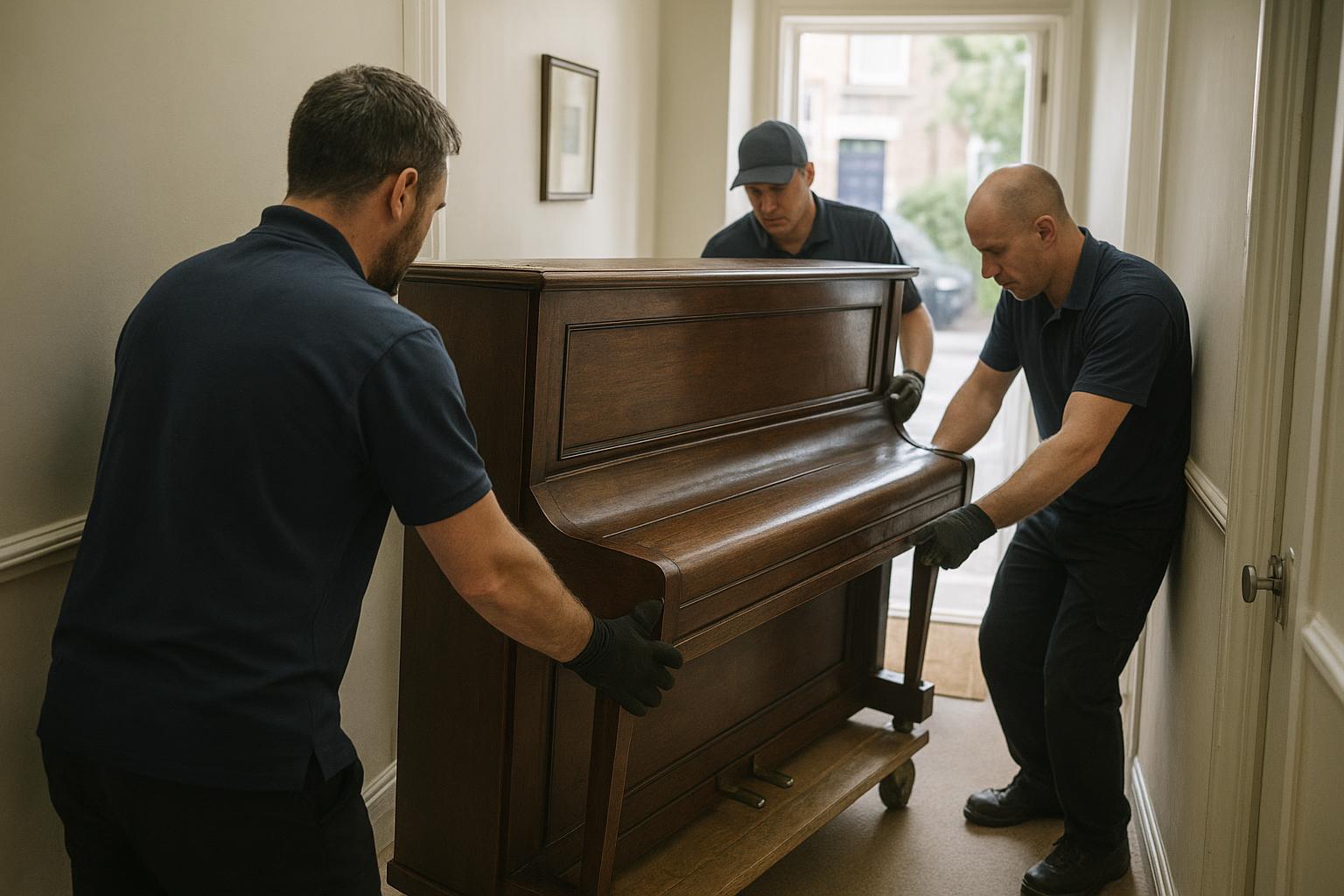
A piano is dense. The frame is cast iron or steel, the case is solid wood and there are hundreds of strings under tension. It is also tall, with a heavy back and a delicate front, and it cannot be tilted freely without risking damage to the keys and action. For disposal that matters less than it does for a move, but the crew still has to carry it safely, so the main risk is injury and damage to the property.
That is why carriers often use sack trucks designed for pianos, straps and sometimes extra people. Our guide to moving heavy furniture safely and the PPE and health guidelines for heavy clearances explain why you should not attempt to move a piano yourself, even a small one.
If you are tempted to move a piano with friends, consider the cost of a mistake: a damaged stairwell, a torn floor or an injured back usually costs far more than a professional collection. This is also why we recommend you let a carrier decide the crew size rather than ask for a cheaper two-person quote that may not be realistic.
Floors, stairs and London buildings
Access decides the price more than the piano.
A ground-floor room with a wide hallway is the cheapest case. Each step, turn and narrow door adds time. In London, typical problems include:
- Steps outside. A flight of front steps can count as a flight of stairs in the quote.
- Narrow hallways and tight turns. Common in Victorian and Edwardian terraces and conversions.
- Lifts. A lift in a mansion block or new-build can help, but a piano may exceed its load limit or depth. Check with the building manager.
- Basement flats. Stairs may go down rather than up, and the route can include an area stair and a tight door.
- Parking. Our prices page notes that parking in controlled zones or on red routes may need a visitor permit, or a council suspension fee of about £35 to £90 per day, depending on the borough.
- Congestion Charge. The standard TfL charge is £18 when applicable. Whether it affects your quote depends on the vehicle, route, time and what the provider has included, so confirm with the provider.
The ordinary stair supplement on our prices page, about £30 to £60 per flight, relates to ordinary items. As the piano page above says, a piano will be higher because of the weight and the extra people required.
Your options: sell, donate or scrap
Not every piano is worth money, and not every one is free to give away.
Before paying for disposal, check whether the piano has any value or a taker. Some are collected by buyers or charities when they are in playable condition, but many are not wanted, and you may be asked to arrange and pay for moving. Our piano disposal guide sets out the routes in detail. If it is part of a house clearance, ask the carrier to include it: house clearance prices are normally quoted for the whole job, which can be cheaper than a separate trip. See also how to move heavy furniture safely and the furniture donation guide.
Does your piano have any value?
A realistic view of resale and donation.
Pianos used to be a staple of every sitting room, and a good deal of the demand for second-hand instruments is for modern, playable ones. A modern instrument in good playing condition, in tune or close to it, may find a taker. An old or damaged upright with a cracked frame or a pest problem is unlikely to. Our piano disposal guide describes the situation in detail.
Some practical tests are worth applying before you spend money on disposal:
- Do all the keys work, and does the instrument hold its pitch?
- Is the case free of woodworm or damp damage?
- Is the piano from a known maker, and is there a serial number you can look up?
- Can a buyer or charity collect it themselves, at their own cost?
- Does the person taking it understand that you will not pay for the move?
If the answers are mostly no, disposal through a licensed carrier is probably the cleaner option. If the answers are mostly yes, ask a local music shop, school or community group before you pay for a collection. See also the furniture donation guide, though many organisations do not accept pianos at all.
What happens to a piano that is scrapped
Dismantling and recycling.
A piano that is not wanted for reuse is usually broken down. The cast-iron frame and metal parts go for recycling, and the wooden case may be processed or disposed of with wood waste. This takes time and labour, which is why scrapping a poor piano is not free even though it has no resale value. If a carrier offers to take it away very cheaply, ask where it is going and whether they are a registered waste carrier. You can check the register on the government's waste carrier registration page.
Decision guide: keep, give, sell or scrap
A simple way to pick a route.
| Condition | Likely best route | Notes |
|---|---|---|
| Good, playable, modern | Offer to a school, community group or buyer | Check who pays for the move before you agree |
| Playable but worn | Try a local advert or a music shop, then fall back to a carrier | Do not delay a collection indefinitely |
| Not playable or damaged | Licensed carrier for scrapping | Expect to pay for labour and disposal |
| Digital piano | Electrical-waste route or carrier | Describe it as a digital piano when you post |
| Grand piano | Specialist quote | Priced individually |
Whichever route you choose, set a deadline. A piano that has been waiting for a buyer for months is still taking up space and may delay a house sale, a refurbishment or a tenancy handover.
How to prepare for a piano collection
Access details save the most money.
- Say which floor it is on and how many steps there are inside and outside.
- Measure doorways and note any turns or narrow sections.
- Clear the path and move fragile items away from the route.
- Tell the carrier if the piano is damaged, has loose parts or has a lid that opens.
What to check when you compare piano quotes
Piano quotes vary more than most, so be precise.
- Floor and route. Has the carrier confirmed the floor, steps and any lift, rather than assuming a ground-floor job?
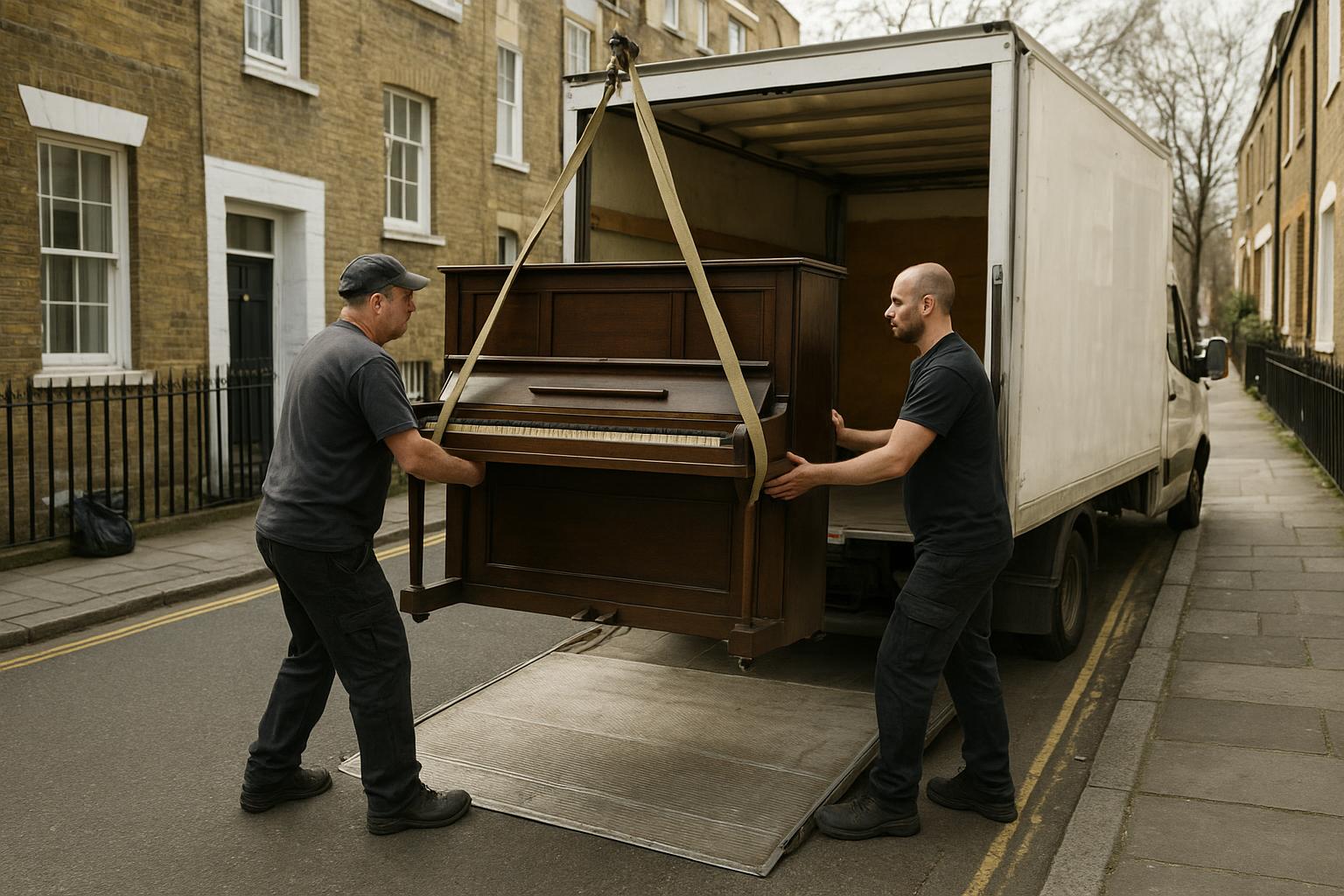
- Crew size. A piano on an upper floor normally needs more than two people. Is that what is quoted?
- Equipment. Will they bring a piano trolley, straps and floor protection?
- Reuse or scrap. Is the piano going for disposal, or is the carrier intending to resell it? The answer can affect the price.
- Registration. Does the carrier hold a waste carrier registration, and will they give you a record of the collection?
- Damage cover. Ask what happens if a wall or bannister is damaged. See our guide to choosing a licensed company for the questions to ask.
You can ask follow-up questions through the platform and you have no obligation to accept any quote.
Your legal responsibility
You remain responsible for where the piano ends up.
A piano is household waste once you decide to dispose of it, and householders have a duty of care to pass waste only to someone authorised to take it. See our householder duty of care guide for the plain-English version. Passing a piano to an unlicensed collector who dumps it can lead back to you. Background on the wider problem is on the fly-tipping page. Keep the booking confirmation and the carrier's details, and avoid cash-only offers with no paperwork.
If your piano is going to a school, church or community group, get the arrangement in writing, including who is paying for transport and who is responsible for any damage on the way out.
What happens on the day
A typical sequence, so there are no surprises.
Once you have chosen a carrier, confirm the date and the arrival window the day before. On the day, the crew will normally look at the piano and the route first, then lay protection on floors and corners, and then lift and carry in a planned sequence. The aim is to move steadily rather than quickly, particularly on stairs.
- Be ready to point out the piano and the route, and to move anything fragile away from the path.
- Keep children and pets in another room while the crew works, since a piano is not something to be near if it slips.
- Make sure the front door can be held open and that any gates, bollards or lift bookings are ready.
- Check the room afterwards for marks or damage while the crew is still there, so that any issue is raised straight away.
- Ask for a record of the collection, such as a confirmation message or receipt, for your own files.
If anything differs from what you described, such as a narrower stair than you said, the crew may revise the price. Being accurate in advance is the best protection against that.
Permissions in flats and managed buildings
Check the building rules before the day.
In a leasehold flat or managed block, there may be rules about moving large items through shared areas. Some buildings require lift booking, floor protection or notice to the managing agent, and some have restricted hours. Contact the managing agent or concierge early and ask what is needed, then pass the details on to the carrier. A crew turned away at the door still has to be paid for the visit in many cases, so it is worth confirming the rules. Our moving day preparation guide has a checklist that applies equally to a large collection.
How the process works, start to finish
Three steps from description to collection.
Describe the job
Say what type of piano it is and whether it is for disposal or reuse, roughly how much there is and anything you want to keep.
Add access and timing
Mention the floor, steps, doorways and where a vehicle can park.
Get a carrier quote
Post the job, compare licensed carriers' quotes and choose, with no obligation to accept.
Other heavy and awkward items in the same job
Pianos often travel with other bulky pieces.
A piano is often the largest of several heavy items. If you are also clearing a washing machine, a sofa, a wardrobe or exercise equipment, post the whole list so carriers can plan the crew and vehicle. Several of these items have their own cost guides: sofa removal costs, wardrobe and bed removal costs, furniture and bulky item costs and moving gym equipment. Grouping them is usually cheaper than separate visits, because the crew, the vehicle and the stair-carrying are shared.
Frequently asked questions
How much does it cost to remove a piano in London?
Indicatively £150 to £250 for an upright from the ground floor and £250 to £450 or more from an upper floor by stairs. The real price is the quote you receive.
Why are pianos so expensive to move?
They are very heavy and awkward, and stairs mean more people and specialist handling.
Will a carrier take a piano that does not work?
Usually yes, for disposal. Say it is damaged when you post so the crew can plan.
Can I give my piano away?
Sometimes. Some charities and schools take pianos in good condition, but many are not accepted, so check before arranging moving.
Is a grand piano priced the same as an upright?
No. Grand pianos need specialist handling and are priced individually.
Can a piano be part of a house clearance?
Yes. Include it when you post the job so the quote covers everything.
Can I move a piano myself?
It is strongly discouraged. Pianos are very heavy and awkward, and mistakes can cause injury and property damage. A carrier with the right crew and equipment is the safer choice.
Do I have to pay to get rid of a piano?
Often yes. Unless a buyer, school or charity collects it, you pay for the labour and disposal. Check whether your piano has any reuse value before paying for scrapping.
What information does a carrier need to quote for a piano?
The type (upright or grand), the floor, the number of steps inside and outside, door and stair widths, parking and photographs. The more precise you are, the more reliable the quote.
Does a digital piano count as a piano for pricing?
Not in the same way. A digital piano is much lighter, but it is electrical equipment and should not go in general waste. Describe it when you post.
Can a piano be collected from a basement?
Yes, but say so when you post. A basement can have steep or narrow stairs and tight doors, which affect the crew size and the quote.
Will the carrier protect my floors and walls?
Ask when you compare quotes. A professional crew normally uses protection, but it is worth confirming what they do and what happens if something is damaged.
Ready to see your price?
Post your piano removal job for licensed carriers to quote on.