
Direct answer
There's no single UK-wide skip permit cost - every council sets its own fee, its own application process and its own processing time, so a figure that's accurate for one borough can be wrong for the next one over. Before you book a skip for a public highway placement, check three separate things: the council's skip permit fee itself, whether a separate parking bay suspension charge applies if the skip sits in a paid or resident bay, and how much lead time the council needs to process the application. In common UK practice the skip hire company applies for the permit on your behalf, but that isn't universal, so confirm it directly with whoever is quoting the job rather than assuming either way.
Contents
- The three things people confuse: permit fee, parking suspension, lead time
- Who actually applies for the permit
- Why a permit doesn't reserve the space
- The legal background: why a permit is required at all
- Permit cost checklist: what to find out from your council
- Worked example: building a realistic skip budget
- When the permit is the deciding cost: comparing a labour-included clearance
- Placement in London: where a skip can and cannot sit
- A realistic timeline: from enquiry to collection
- Questions that make skip and permit quotes comparable
- Duty of care: checking who takes your waste
- Frequently asked questions
The three things people confuse: permit fee, parking suspension, lead time
Three separate costs and processes, often bundled together in people's heads as "the permit."
When a skip needs to go on a public road, pavement or verge rather than entirely on private land such as a driveway, most people assume there's one charge to sort out. In practice there are usually up to three separate things to check, and they don't always come from the same part of the council or move on the same timeline.
| Option or job scenario | What it includes | Main restriction | What to confirm before booking |
|---|---|---|---|
| Skip entirely on private land | No highway permit needed - the skip sits on a driveway, front garden or other private space | Must be fully within the property boundary, not overhanging the pavement or road | Whether the access route to place the skip crosses any public footway |
| Skip on a public road, pavement or verge (standard permit) | Council permission to place a skip on the public highway, usually with conditions on siting, marking and lighting | Fee and exact conditions set independently by each local council - not a single UK figure | The current fee on your own council's permit page, and how the application is submitted |
| Skip placed in a paid or resident parking bay | A separate parking bay suspension, on top of the standard highway permit, typically arranged with the council's parking team | Usually a distinct process and a distinct fee from the skip permit itself | Whether your chosen spot is inside a controlled parking zone or bay before assuming the permit alone covers it |
| Lead time for processing | The notice period a council needs between application and the skip being placed | Varies by council - some process in a few working days, others take considerably longer | Your council's stated processing time, checked against your planned delivery date |
Because the fee, the process and the lead time are all set locally, the only reliable way to get a real number for your job is to check your own council's permit page directly, or ask the skip hire company quoting the work - not to rely on a figure that applied somewhere else.
Who actually applies for the permit
Worth confirming directly rather than assuming either direction.
In common UK practice, it's very often the skip hire company that applies for the permit on the customer's behalf, partly because a number of councils only accept applications from a registered skip operator rather than a member of the public directly. That said, this isn't a universal rule - the exact arrangement varies by provider and by council, and some setups do expect the person booking the skip to handle the application themselves. Don't assume either direction is automatic: ask the company quoting your skip hire job whether they submit the permit application as part of the service, or whether that's left to you.
If the job involves ongoing builders and renovation waste over several weeks, it's also worth checking whether the permit needs renewing partway through the project, since a single permit doesn't necessarily cover the entire duration of a longer job.

Why a permit doesn't reserve the space
A common and avoidable assumption worth correcting.
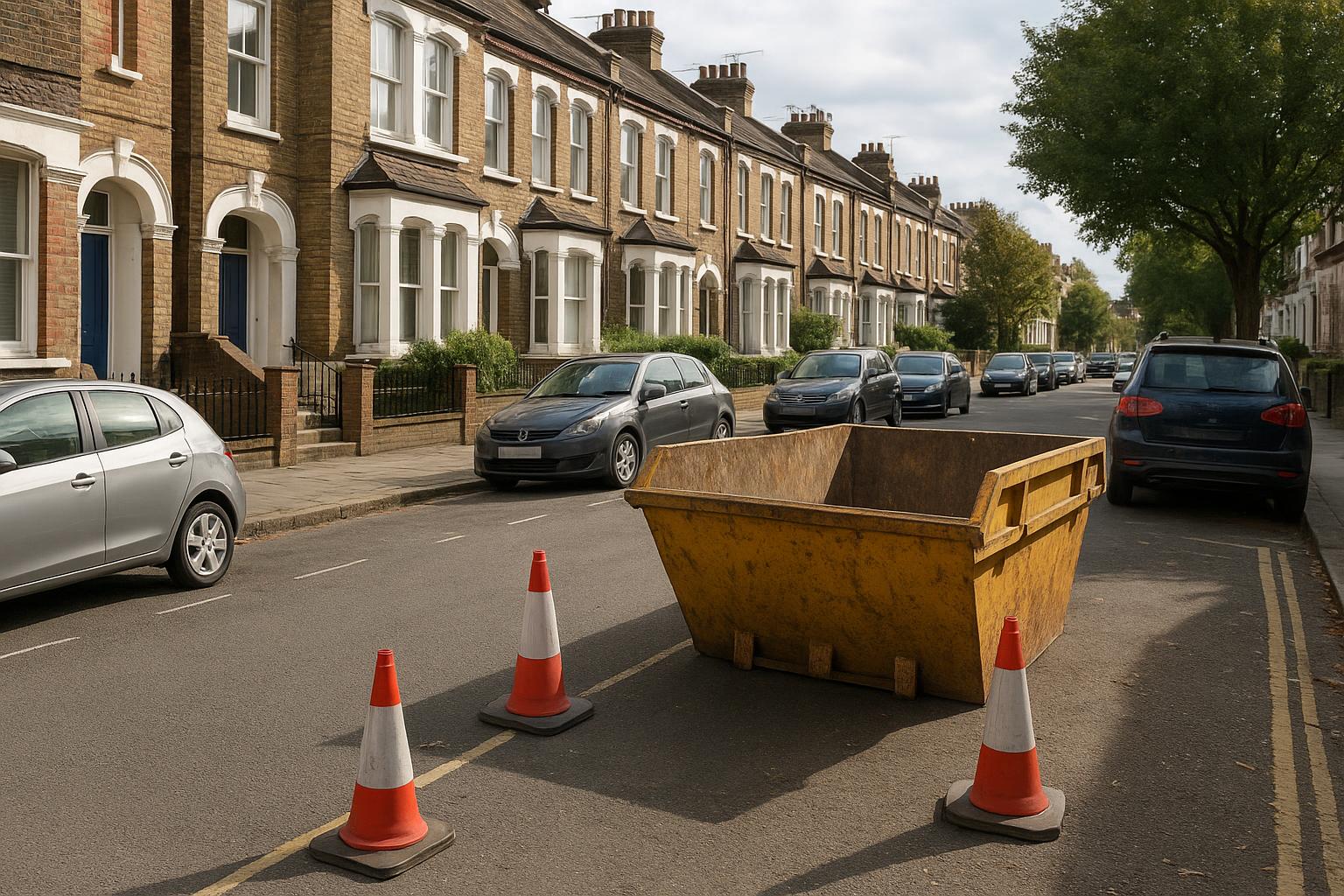
A skip permit gives the council's permission to place a skip on the highway - it doesn't physically reserve or guarantee that parking space in the meantime. Nothing about holding a permit stops another vehicle parking in that spot before the skip is delivered, and the permit itself is a separate document from any parking bay suspension that might also be needed. Treating the permit as if it locks in the space is a common mix-up, and it's worth checking with whoever is delivering the skip what happens if the spot is occupied on the day, rather than assuming the permit alone has taken care of it.
The legal background: why a permit is required at all
General UK regulation, not a houseclearance.co-specific claim.
The requirement for a permit isn't just a council preference - it's set out in law. Under the Highways Act 1980, a skip must not be placed on a public highway without the permission of the highway authority responsible for that road, and the authority can attach conditions covering siting, dimensions, marking and lighting. Placing a skip on the highway without that permission is an offence, and the skip's owner can be liable for a fine. This is why most skip hire companies treat the permit as a standard part of booking a highway placement rather than an optional extra. For the legal text itself, see:
Permit cost checklist: what to find out from your council
Seven questions that turn "how much is the permit?" into a number you can actually budget with.
Because the fee, the process and the lead time are all set by your own council, the most useful thing you can do before booking is turn a vague worry into a short list of specific questions. Most councils publish the answers on a skip permit or highways licensing page, and where they don't, a phone call to the highways or street works team usually settles it. Work through the list below and write the answers down before you accept any quote, because every answer feeds into either the final cost or the delivery date.
- What is the current permit fee? Take the figure from the council's own page, not from a forum post or an article about a different borough. Note whether it is quoted per skip, per week or per application.
- How long does one permit last? Some permits are issued for a fixed number of days. If your project could overrun, ask what a renewal or extension costs and how much notice it needs.
- Does the council accept applications from the public, or only from registered skip operators? This decides who submits the form and whether you need to pay the skip company in advance.
- Is the planned spot inside a controlled parking zone, a paid bay or a resident bay? If it is, a separate parking bay suspension is likely, with its own fee and its own lead time.
- What are the siting conditions? Councils can set conditions about distance from junctions, access for other road users, and marking and lighting of the skip. Ask for them in writing so you and the skip company are working from the same list.
- What is the processing time? Compare it against the day you actually want the skip. A permit that arrives a day after the delivery slot is no use to anyone.
- What happens if the permit is refused or delayed? Ask the skip company whether the booking can be moved without a charge, and whether any deposit is held.
Keep the answers together with the skip quote. When two quotes look different, it is often because one includes the permit application and the other leaves it for you to arrange, so the cheaper-looking figure may simply be missing a line. Writing the permit fee, any suspension fee and the processing time next to each quote makes the comparison fair.
Worked example: building a realistic skip budget
Illustrative arithmetic only - not a customer job and not a quote. It shows how the separate pieces add up.
To show how the three costs combine, take an imaginary three-day clear-out where a skip has to sit on a residential street inside a controlled parking zone. The arithmetic below is illustrative: the permit fee is shown as a placeholder because it is set by your own council, and the suspension range is the published indicative range for parking suspension booking fees on the /prices/ page, which quotes £35 to £90 per day depending on the borough.
| Budget line | How to find the number | Illustrative figure |
|---|---|---|
| Skip hire itself | Quoted by the skip company by size and hire period - not covered on /prices/ | Taken from your own quote |
| Council skip permit | Your council's permit page, or the skip company if it applies for you | Taken from your council's current fee |
| Parking bay suspension, per day | Indicative range on /prices/: £35 – £90 per day depending on borough | £35 – £90 per day |
| Suspension for three days | Three days multiplied by the per-day range | £105 – £270 |
| Extension if the job overruns | Per-day or per-week rate agreed with the skip company before booking | Taken from your own quote |
Reading the table: the only two lines that carry a published range are the suspension rate and its three-day total, and both come from the same /prices/ range, so that part of the arithmetic is simply 3 x £35 = £105 and 3 x £90 = £270. Everything else depends on your council or your supplier. The point of the exercise is not the total, which you cannot know without the other quotes, but the structure: a skip on a controlled-zone street can have four or five separate cost lines, and a quote that shows only one of them is not the whole picture.
Now compare the same job with a driveway placement. With no highway involved, the permit line and the suspension lines drop to nothing, and what remains is the skip hire price and any extension. That is why the first question on any skip enquiry should be where the skip will physically sit.
When the permit is the deciding cost: comparing a labour-included clearance
A skip is not the only way to remove a load - and the permit is a cost that a different route can sometimes avoid.
A skip suits a long, messy job where you want to fill a container at your own pace. It is a weaker fit for a one-off clear-out where the permit, the suspension and the waiting time cost as much as the waste itself. In that situation it is worth getting a comparison figure for a labour-included clearance, where a licensed carrier brings a van and a crew, removes everything from inside the property and takes it away the same day. The /prices/ page publishes indicative ranges by van load, reproduced below.
| Van load equivalent | Cubic capacity | Indicative London price |
|---|---|---|
| Single item minimum charge | 1 – 2 cu yd | £65 – £95 |
| 1/8 van load | 2 cu yd | £95 – £135 |
| 1/4 van load | 4 cu yd | £145 – £195 |
| 3/8 van load | 6 cu yd | £210 – £265 |
| 1/2 van load | 8 cu yd | £275 – £345 |
| 3/4 van load | 12 cu yd | £425 – £495 |
| Full van load | 16 cu yd | £575 – £695 |
These are indicative ranges for labour-included jobs, not skip prices, and the real price is whatever a licensed carrier quotes once they know your load and access. On houseclearance.co you post the job once, suitable carriers covering your postcode get in touch with their own quotes, and you can compare them or accept none of them. The carriers are independent businesses, so there is no single company-wide price, and whether VAT applies depends on the carrier and is shown in the quote.
Be careful with the comparison, though. A van still has to park, and where it must stand on yellow lines, a red route or inside a controlled zone, the same /prices/ page notes that a temporary visitor permit or a council suspension booking fee can come into play. The advantage of the van route is mainly that the vehicle is there for a short loading window rather than sitting on the road for days, so the exposure to permit conditions is shorter. For the fuller side-by-side, see our house clearance vs skip hire guide.
Placement in London: where a skip can and cannot sit
Space, neighbours and street furniture decide more than the permit does.
London streets add practical constraints that a national permit explanation rarely mentions. Before you pick a spot, walk the street and look at it the way the council's highways officer would. Is the proposed position clear of junctions and dropped kerbs? Would it block a neighbour's driveway, a bin collection point or a bus stop? Is there a lamp post or tree you would need the skip to clear? Councils can set conditions on siting, so the position you imagine and the position that is approved may not be the same.
Driveway versus road
The simplest route is a driveway or front garden large enough for the delivery lorry to reach. If the access crosses the pavement, check that the skip itself stays wholly within your boundary and that the lorry will not need to stop on the road in a way that causes a problem. Where the driveway is short, ask the skip company about the skip dimensions and whether the lorry can actually tip the skip onto the space.
Roadside placement
- Mark out the space with your own cones or vehicles only if the council allows it - a permit does not stop another vehicle parking in that spot.
- Tell neighbours the day before so that a parked car does not cause a failed delivery.
- Ask whether the skip needs marking, reflective strips or a light, because conditions on marking and lighting can form part of the permit.
- Check overhead and underground obstructions, such as low branches or cables, with the delivery driver.
If the street is narrow or heavily used, the extra effort of arranging a permit and suspension may be better spent looking at a compact option such as a mini skip or at a van-based clearance instead.
A realistic timeline: from enquiry to collection
Illustrative planning sequence - the lead times shown are placeholders for your council's own figures.
| Stage | What happens | What to note |
|---|---|---|
| Decide the location | Choose driveway or highway, and check for any parking bay in front of the property | Highway or bay means the permit process applies |
| Request quotes | Ask for skip hire price, who applies for the permit, and the extension rate | Compare like with like across quotes |
| Permit application | Submitted by the skip company or by you, depending on the council | Check the council's stated processing time |
| Parking suspension (if needed) | Booked with the council parking team for the specific dates | Separate process, separate fee |
| Delivery day | The lorry places the skip in the agreed space | Keep the space clear to avoid a failed delivery |
| Collection day | The skip is collected at the end of the hire period | Keep access clear, and agree any extension in advance |
Count backwards from the day you want to start. If your council quotes a processing time of several working days, add the time needed to request quotes and make a decision, and you may find the sensible starting point is more than two weeks before delivery. If the timeline is too tight, that is a signal to consider a route that does not depend on a highway permit.
Questions that make skip and permit quotes comparable
Ask every supplier the same questions and write the answers beside each quote.
- Does the price include the permit application, the permit fee and any parking suspension, or only the skip?
- Who is named on the permit, and who is liable if the skip is placed without one?
- What is the hire period, and what is the daily or weekly extension rate?
- What weight limit applies, and what is charged for going over it?
- Which materials are not allowed in the skip, and what happens if the wrong material is found?
- What is the charge if the lorry cannot deliver or collect because access is blocked?
- Can the booking be moved without charge if the permit is delayed?
A supplier who answers all seven clearly is easier to budget with than one who gives a single headline price. The cheapest headline figure is often the one that leaves the most lines blank.
Duty of care: checking who takes your waste
Whoever collects the waste, the responsibility for where it ends up does not stop at your front door.
In England, anyone who produces household waste has a duty of care to make sure it is passed only to an authorised person. In practice that means asking whether the skip company or carrier is a registered waste carrier, and checking the registration on the Environment Agency's public register rather than relying on a van sign or a leaflet. Keep a receipt or waste transfer record showing who collected the waste and what it was described as. If waste is later found fly-tipped and can be traced to you, the paperwork is your evidence of having passed it to someone who was meant to handle it properly.
This applies equally to a skip, a man-and-van and a council collection. On houseclearance.co, carriers are asked to hold a valid waste carrier registration before they can quote, but you should still ask to see it, because the duty sits with you as the waste producer. For the wider picture of what happens to waste after collection, see our builders and renovation waste page, which also covers materials that commonly cannot go in an ordinary skip.
Frequently asked questions
The questions that come up most often before booking a skip for a highway placement.
How much does a skip permit cost?
There's no single UK-wide figure - each council sets its own skip permit fee, and the amount, the application process and how long it takes to process all vary by local authority. The only reliable way to get a real number is to check your own council's permit page or ask the skip hire company quoting your job, since they apply on your behalf in most cases.
Do I need a permit if the skip is on my driveway?
Generally no - a skip placed entirely on private land, such as a driveway or front garden, typically does not need a council permit. A permit is normally only required when the skip is placed on a public highway, including a road, pavement or verge.
Does the skip hire company apply for the permit, or do I have to?
In common UK practice, the skip hire company applies for the permit on the customer's behalf, since many councils only accept applications from a registered skip operator rather than a member of the public. This isn't universal, though - confirm directly with the company quoting your job whether they handle the application or expect you to.
Does a skip permit also reserve a parking space for the skip?
No - a skip permit gives permission to place a skip on the highway, but it doesn't stop other vehicles parking in that spot before the skip arrives, and it doesn't substitute for a separate parking bay suspension where one is needed. These are different processes with different rules, and assuming the permit alone guarantees the space is a common and avoidable mistake.
How far in advance should I apply for a skip permit?
As early as possible once you know the skip is going on a public highway - lead times vary significantly by council, with some processing applications in a few working days and others needing considerably longer. Leaving it until the week you want the skip delivered risks a delay if your council needs more notice than you assumed.
What happens if a skip is placed on the highway without a permit?
Placing a skip on a public highway without the permission of the highway authority is an offence under the Highways Act 1980, and the skip's owner can be liable for a fine. This is a real legal requirement, not just good practice, which is part of why most skip hire companies handle the permit application themselves rather than leaving it to chance.
How do I work out the total cost of a skip on a London street?
Add three separate things: the skip hire price from the supplier, the council's skip permit fee, and a parking bay suspension if the skip sits in a paid or resident bay. The /prices/ page gives an indicative range of £35 to £90 per day for suspension booking fees depending on borough, but the permit fee itself is set by your own council, so check its page.
Can a permit be refused or delayed?
Yes. Councils process applications in their own time and can set conditions on where a skip may go, so it is sensible to apply early and ask the skip company what happens to the booking if the permit is delayed.
What happens if I keep the skip longer than the permit allows?
You may need to extend or renew the permit, and the skip company may also charge an extension fee. Ask both questions before booking, especially for renovation work that can overrun.
Is a labour-included clearance cheaper than a skip once a permit is added?
It depends on the load. The /prices/ page shows indicative ranges from £65 to £95 for a single item up to £575 to £695 for a full van load, and a carrier's real quote may differ, so compare it with the full skip cost including permit and any suspension.
Should I check that the skip company is a registered waste carrier?
Yes. As the person producing the waste you have a duty of care, so ask for the registration number and check it on the Environment Agency's public register before you hand over any waste.
Prefer to skip the permit admin altogether?
Post your job for licensed carriers to quote on a labour-included clearance instead.