
Direct answer
Clearing an office in London typically costs about £300 to £600 for a small office up to 500 sq ft and £800 to £2,000 for 1,000 to 2,500 sq ft, or roughly £50 to £85 per workstation. Those are indicative ranges, not a fixed rate card: a licensed carrier quotes the real price for your office, contents and access.
Contents
- What office clearance costs by size
- What moves the price up or down
- Related guides
- How to prepare an office clearance
- Why square footage is only a starting point
- How a carrier builds an office clearance quote
- Worked examples: turning a count into a budget
- Using van-load figures for office jobs
- IT equipment, confidential papers and data
- Furniture, partitions and fixtures
- Access, parking and building rules in London offices
- Lease exit, reinstatement and timing
- Reuse, resale and donation of office furniture
- Office clearance checklist
- Waste duty of care for businesses
- How the process works, start to finish
- Frequently asked questions
What office clearance costs by size
Indicative ranges by square footage.
Office clearances are often quoted by floor area as a starting point, then adjusted for what is in the space. The ranges below are indicative for London. Our prices page also publishes a van-load table, which many office quotes are built on.
| Office size | Indicative price | Notes |
|---|---|---|
| Small office (up to 500 sq ft) | £300 – £600 | A few desks, chairs and storage |
| Medium office (1,000 – 2,500 sq ft) | £800 – £2,000 | Depends on desk count and equipment |
| Per workstation or desk | £50 – £85 | Including the equipment at the desk |
Per square foot is only a rough guide. A sparse 2,000 sq ft space can cost less than a crowded 1,000 sq ft one, so the carrier will want photos or a visit.
What moves the price up or down
Contents matter more than floor area.
- Desks and equipment. Workstations, filing cabinets, partitions and meeting-room furniture add volume.
- IT and electrical items. Computers, monitors and screens fall under electrical waste, and our prices page lists surcharges for TVs, monitors and small electronics.
- Data. Tell the carrier about computers and storage. Data destruction should be handled by you or a specialist, not assumed to be part of the clearance.
- Access. Lifts, loading bays, building access hours and parking all affect time and cost.
- Out-of-hours work. Evening or weekend slots can change the quote.

How to prepare an office clearance
Plan with the landlord and building manager.
- Check your lease for reinstatement and exit conditions.
- Book the lift and loading bay with the building manager.
- Separate items to keep, sell or donate from waste.
- Arrange data removal and confidential paper separately, and say what is in the job.
Why square footage is only a starting point
Two offices of the same size can need very different amounts of work.
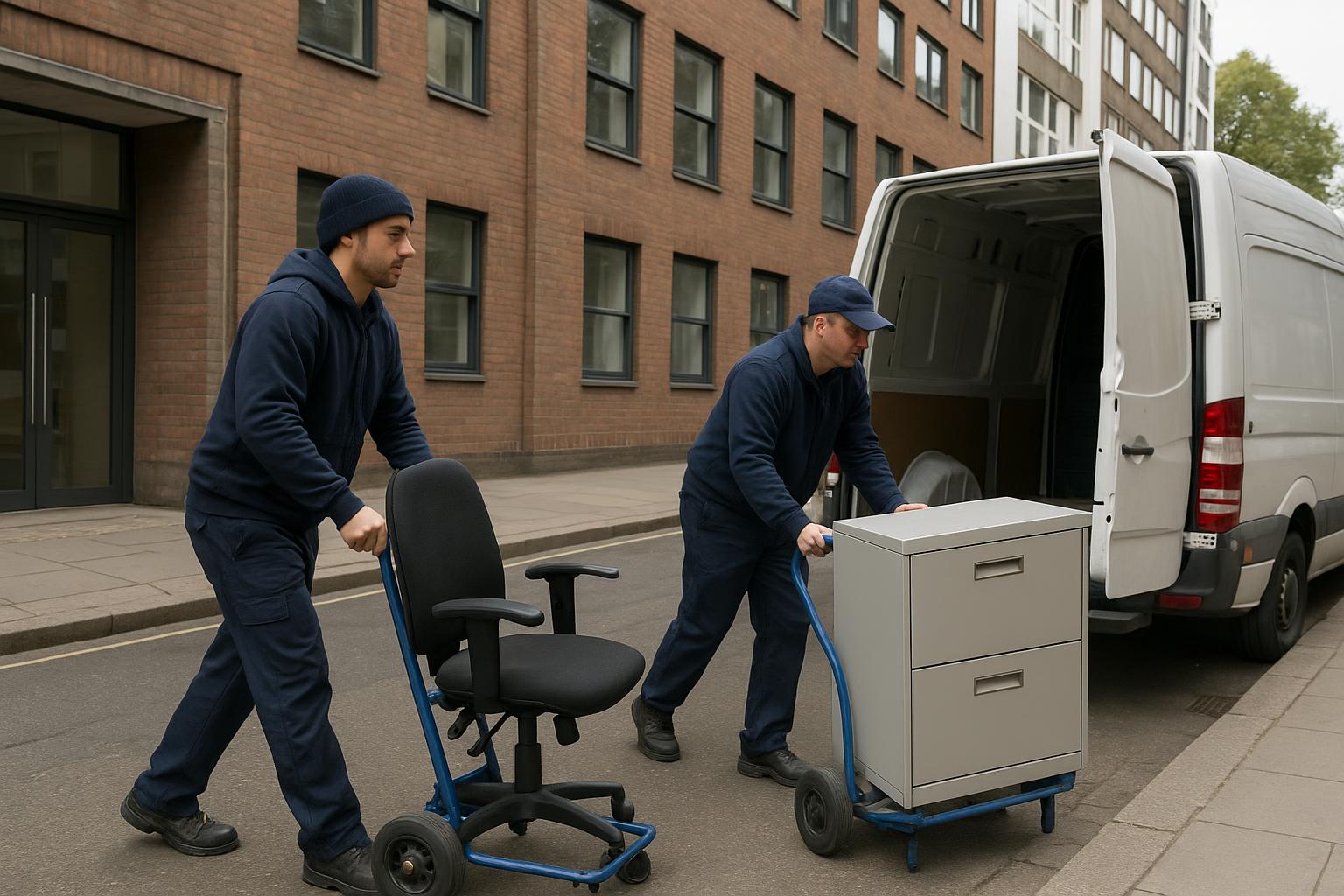
When people search for office clearance cost per square foot, they usually want a single number to multiply by the size of the space. It is an understandable shortcut, but it hides the thing that actually drives the price: what is inside the floor plate. A carrier is paid for labour, vehicle time and disposal, and none of those scale neatly with area. An empty open-plan floor with a handful of desks is quick to clear. The same area filled with back-to-back workstations, full-height filing, a server cupboard and a kitchen takes a crew far longer and fills several vehicles.
Floor area is still useful as a first filter. It tells a carrier roughly how large the job could be and whether they should send one vehicle or several. That is why the ranges in this guide are shown by size band. But treat them as a way to sense-check the quotes you receive, not as a rate you can calculate. The real price comes from carriers who have seen your photos or visited the space.
The most reliable way to estimate an office job is to count what is in it. Desks, chairs, pedestals, cabinets, screens, partitions and kitchen equipment can be counted, photographed and described, and that description is what a carrier quotes against. The sections below show how to do that and how to turn the numbers on our prices page into a rough budget.
How a carrier builds an office clearance quote
The five things that make up the figure.
- Volume to remove. Carriers think in van loads. Our prices page shows indicative ranges from a single-item minimum up to a full van, and large offices are quoted as several loads or as a dedicated crew and vehicle for a day.
- Labour and time. Dismantling workstations, carrying out heavy cabinets and moving items down stairs or to a loading bay all take crew time. The time on site often matters more than the distance.
- Regulated items. Padded office chairs, monitors, TVs, appliances and fridges have their own disposal charges, listed on the prices page.
- Access and restrictions. Lift booking, loading bay slots, parking suspensions and building rules affect how long the crew needs and what the carrier has to pay for.
- Resale value. Some carriers will reduce a quote if there is good furniture they can resell. That is the carrier's choice and never guaranteed.
This is why we describe every figure as indicative. Each carrier on the platform quotes independently, based on the scope you describe. When you receive several quotes, compare what each one covers rather than only the headline number.
Worked examples: turning a count into a budget
Illustrative arithmetic using published figures, not real jobs.
The examples below are illustrations of how to use the indicative figures. They are not real customer jobs and they are not quotes. They show how a rough budget is built from our prices page before you collect actual quotes.
Example 1: a small team office of 400 sq ft
Imagine a small office with six desks, six padded chairs, a few pedestals and a small meeting table. Using the guide range, the whole job sits in the indicative £300 to £600 band for an office up to 500 sq ft. Cross-check it with the per-desk figure: six workstations at £50 to £85 each gives £300 to £510, which falls inside the same band. Our prices page lists a padded office chair disposal surcharge of £15 to £25 each, so six chairs account for roughly £90 to £150 of any total, which is a useful reminder that the regulated items are part of the figure, not an extra on top of a single headline number.
Example 2: a 1,500 sq ft floor with 20 workstations
Now imagine a mid-sized floor with twenty workstations, a small kitchen and a meeting room. The guide range for 1,000 to 2,500 sq ft is £800 to £2,000. The per-desk shortcut gives twenty desks at £50 to £85, or £1,000 to £1,700 before the kitchen and meeting room are added. Those two methods overlap well, which gives you confidence that a quote in the region of £1,000 to £2,000 is plausible, while a figure far outside it is a prompt to ask what is or is not included.
Example 3: a sparse large space
A 3,000 sq ft space that has already been mostly emptied by the tenant, with ten desks left behind, will cost far less than the area alone suggests. The count of ten workstations is the better guide. This is the main way the per-square-foot approach misleads: it overestimates sparse space and underestimates a crowded one.
In all three cases the next step is the same. Post the job with a count and photos and see what licensed carriers quote.
Using van-load figures for office jobs
The table behind many office quotes.
Our prices page publishes indicative prices by van load, based on a standard 3.5 tonne Luton van with about 16 cubic yards of internal capacity. Many office quotes are built from this, because it lets a carrier express a mixed pile of furniture in one unit.
| Load | Cubic yards | Indicative price |
|---|---|---|
| Single item minimum | 1 – 2 | £65 – £95 |
| 1/4 van load | 4 | £145 – £195 |
| 1/2 van load | 8 | £275 – £345 |
| 3/4 van load | 12 | £425 – £495 |
| Full van load | 16 | £575 – £695 |
A rough way to use the table is to ask how many van loads your furniture would fill. A desk with a pedestal takes up a modest share of a van, and a run of cabinets takes more. Large offices are often several full loads, so the cost is a multiple of the full-van range plus labour for the extra carrying. The result will not match a carrier's quote exactly, but it gives you a ballpark to test quotes against.
Heavy items change the picture. Filing cabinets full of paper, safes and metal shelving reach the weight limit of a vehicle before they fill the space. Say so in your job post so the carrier plans for it.
IT equipment, confidential papers and data
The part of an office clearance that carries the most risk.
Offices usually contain computers, monitors, printers, phones, cabling and networking equipment. These are electrical waste and cannot go in ordinary rubbish. Our prices page lists indicative disposal charges for items such as monitors under 40 inches (£15 to £25), larger commercial screens (£30 to £50) and small electronics (£10 to £20 per unit), and our electronic waste and WEEE clearance service covers the wider category.
Data is a separate matter. A clearance carrier removes equipment; it is not automatically a data destruction service. If computers, servers, phones or storage devices hold company or customer information, you remain responsible for making sure the data is wiped or destroyed properly before the equipment leaves, or for using a specialist who provides evidence of destruction. Tell the carrier what is on site so the quote and the plan are accurate.
Paper records need the same attention. Boxes of files, archived contracts and HR records should be sorted into what must be kept, what can be shredded and what can be recycled. Our confidential waste and document clearance service explains the options. Do not assume that a general clearance quote includes secure shredding.
Furniture, partitions and fixtures
What counts as a fixture and what does not.
Free-standing furniture such as desks, chairs, pedestals, tables and cabinets is straightforward to remove. Fixtures are different. Partitions, suspended ceilings, carpet tiles, built-in kitchens, signage and cabling may belong to the landlord or be part of your reinstatement obligations under the lease. Check who owns each item before it is removed.
If partitions are being taken down, tell the carrier. Stud partitions create plasterboard and timber waste, and our prices page lists plasterboard separately by weight (£240 to £360 per tonne) because it has to go to specialist recycling rather than landfill. Dismantling work is also normally a job for a fit-out or strip-out contractor rather than a standard clearance team, so say clearly what you expect.
Specialist items such as commercial fridges can have higher disposal charges. The prices page shows a commercial display fridge at £140 to £220, for example. List each of these in your post.
Access, parking and building rules in London offices
Why a central London job can cost more than the same job elsewhere.
- Lifts and loading bays. Many London office buildings require goods lifts and loading bays to be booked, and may restrict the hours when they are available. A crew waiting for a lift is a crew being paid for waiting.
- Stairs. Where there is no lift, our prices page notes that carrying down stairs typically adds about £30 to £60 per flight.
- Parking and loading. Our prices page notes that where a vehicle must park in a controlled zone, a carrier may need a parking suspension, which the page indicates can range from £35 to £90 a day depending on the borough. Ask your building manager what is possible.
- Congestion Charge. The page notes the standard TfL charge is £18 per day where it applies. Whether it applies depends on the vehicle, route and time, so check current TfL guidance and confirm what each carrier has included.
- Insurance and induction. Some managing agents ask contractors for proof of insurance or a short site induction before they are allowed in. Ask early and pass the requirement on when you post.
The best way to avoid surprises is to speak to the building manager before you post, then put the answers in your job description. Our guide to parking suspensions for clearances explains how bay suspensions work.
Lease exit, reinstatement and timing
Why the deadline often sets the cost.
Many office clearances happen because a lease is ending. The lease may require you to hand the space back empty, clean and sometimes returned to its original condition. Clearance is only part of that, and a landlord may assess dilapidations separately, so read the break clause and any reinstatement schedule before you plan the clearance.
Timing matters for price. Booking early gives more carriers time to respond and gives you room to compare. Last-minute requests tend to limit options. Evening and weekend slots can suit offices that must stay open during the day, but the quote may reflect it, so say when you need access when you post.
If the move is to a new space, a clearance and a relocation are different jobs. See the office removals planning guide for relocation and keep clearance for what you will not take with you.
Reuse, resale and donation of office furniture
Good furniture is sometimes worth more than it costs to move.
Quality desks, ergonomic chairs and meeting tables sometimes have resale value, and some carriers will take that into account in their quote. This is not guaranteed and depends on condition, quantity and demand. If you have a lot of good furniture, mention it and share photos, because a carrier may price the job differently if they can resell what they take.
Donation is another route. Charities and reuse schemes may collect furniture in good condition, but rules and timescales differ and they will not take damaged or fire-unsafe items. See our furniture donation guide for what to check. Where an office is being cleared in a hurry, it is usually simpler to ask carriers what they can reuse rather than arranging several separate collections.
Office clearance checklist
A practical order of work.
- Read the lease for exit, reinstatement and notice requirements.
- Count desks, chairs, cabinets, screens and larger items and take photos of each area.
- Decide what is being kept, sold, donated or discarded and label accordingly.
- Arrange data wiping and confidential paper handling before any equipment leaves.
- Book the lift, loading bay and building access with the building manager.
- Check who owns partitions, fittings and built-in items.
- Post the job with the counts, photos, floor, lift and timing details.
- Compare licensed carriers' quotes and ask what each includes, including disposal paperwork.
- Keep the waste transfer paperwork you are given.
Our waste transfer notes guide explains the paperwork, and our guide to choosing a licensed clearance company sets out what to check before you accept a quote.
Waste duty of care for businesses
Your responsibility does not end when the vehicle leaves.
A business that produces waste has a legal duty of care to make sure it is handled by someone authorised to take it. In practice, that means using a registered waste carrier, keeping the paperwork you are given and not handing waste to someone you cannot identify. You can check a carrier's registration on the government service and ask for the details before you accept a quote. Our waste carrier licence page explains what the platform checks before carriers can quote.
Our responsible disposal page explains what happens to waste afterwards, and the fly-tipping liability guide explains why the choice of carrier matters. For businesses with regular waste, see the B2B and scheduled waste management service.
How the process works, start to finish
Three steps from description to collection.
Describe the job
Say what size of office it is and what is in it, roughly how much there is and anything you want to keep.
Add access and timing
Mention the floor, lift, loading bay and out-of-hours access.
Get a carrier quote
Post the job, compare licensed carriers' quotes and choose, with no obligation to accept.
Frequently asked questions
How much does an office clearance cost in London?
Indicatively £300 to £600 for a small office up to 500 sq ft and £800 to £2,000 for 1,000 to 2,500 sq ft. The real price is the quote you receive.
Is it priced per square foot?
Only as a rough guide. The quote depends mainly on what is in the space.
What is the cost per desk?
Indicatively £50 to £85 per workstation including equipment.
Who deals with confidential data?
You should. Remove or destroy data and confidential papers separately or use a specialist, and tell the carrier what is involved.
Can furniture be reused or sold?
Sometimes. Some carriers may resell or donate good furniture and reduce the quote, but there is no guarantee.
Can it be done out of hours?
Often yes. Say when you need it done when you post.
What is the cost per desk for an office clearance?
Indicatively £50 to £85 per workstation including the equipment at the desk, based on the figures in this guide. Large numbers of desks, heavy cabinets or difficult access change the quote.
Why is a sparse large office sometimes cheaper than a small crowded one?
Because the price follows the amount of contents and the labour to remove them, not the floor area. Ten desks in a 3,000 sq ft space are less work than thirty desks in 1,000 sq ft.
Do I need to wipe the computers before the clearance?
You are responsible for the data. Wipe or destroy it, or use a specialist who provides evidence, before equipment leaves. A clearance carrier removes the items but should not be assumed to be a data destruction service.
Does the quote include the lift and parking costs?
It depends on each carrier. Ask whether parking suspensions, Congestion Charge and any lift or loading bay arrangements are included, and check against the notes on our prices page.
Can the carrier remove partitions and fitted units?
Sometimes, but it is usually a separate strip-out task and may involve the landlord. Describe exactly what you want removed in your job post and check who owns it first.
How far in advance should I book an office clearance?
As early as you can, particularly if the lease end date or building access slots are fixed. Early posts give carriers time to respond and give you more quotes to compare.
Ready to see your price?
Post your office clearance for licensed carriers to quote on.