
Direct answer
There are genuinely free ways to dispose of a mattress, but each one has a condition attached. Taking a mattress yourself to a household recycling centre is free for residents at most London councils, though some limit how many you can bring per year or ask you to book ahead. Donating to a charity is only an option if the mattress is clean, undamaged and still carries its original permanent fire safety label - charities that resell items generally cannot legally accept one without it. Some retailers will remove your old mattress when delivering a new one, though this varies by retailer and isn't automatically free, so it needs confirming directly. What's rarely free is having a mattress collected from your home - a council bulky waste collection or a private clearance both charge for that labour, even though the mattress itself may end up going to the same recycling centre.
Contents
- Free mattress disposal options compared
- Donating a mattress: condition and fire safety label
- Taking a mattress to a recycling centre yourself
- Retailer take-back when buying a new mattress
- When mattress disposal stops being free
- Why "free" often stops at the front door: what disposal actually costs
- Worked examples: free route or paid route?
- Hygiene, damp and condition: which routes accept what
- Moving a mattress safely in a London home
- Questions to ask before you choose a route
- Frequently asked questions
Free mattress disposal options compared
What each route actually requires before you rely on it.
"Free" covers a few genuinely different situations, and the right one depends on the mattress's condition and how you're able to transport it. The table below sets out what each option includes, its main restriction, and what's worth confirming before you commit to it.
| Option or job scenario | What it includes | Main restriction | What to confirm before booking |
|---|---|---|---|
| Household recycling centre, self-delivered | Drop the mattress off yourself; most sites accept it as standard household waste, free for residents | You need your own way of transporting a bulky, heavy item | Whether your council limits mattresses per year, requires booking a slot, or asks for proof of address |
| Charity donation or collection | A charity takes the mattress for reuse, sometimes with free collection from your home | Must be clean, undamaged and carry its original fire safety label | Whether the specific charity collects mattresses at all, and what condition and labelling they require |
| Retailer take-back with new mattress purchase | The retailer removes your old mattress when delivering the new one | Not offered by every retailer, and not always free even when offered | Whether it's included in the price, any condition the old mattress must meet, and how collection is arranged |
| Council bulky waste collection | Council collects the mattress from your home on a scheduled visit | Almost always carries a charge, which varies by council | The fee, how far ahead you need to book, and whether there's a limit on items per collection |
| Private clearance or removal service | A carrier collects the mattress, often alongside other items, as part of a wider clearance | Charged for the labour and transport, not just the mattress itself | Whether it's worth bundling with other items being cleared at the same time - see furniture and bulky item removal cost |
Donating a mattress: condition and fire safety label
The fire safety label is the main thing that decides whether a charity can accept a mattress at all.
The Furniture and Furnishings (Fire)(Safety) Regulations 1988 cover mattresses in the same way as other upholstered furniture such as sofas and armchairs - beds, headboards and mattresses of any size fall within scope, with fillings required to meet set ignition-resistance standards. A charity distributing items free or at a nominal cost direct to someone in need is generally exempt from the regulations, but a charity that resells donated items - most charity shops - generally cannot legally accept or resell a mattress that no longer has its original permanent fire safety label attached, however good the mattress otherwise looks.
In practice, that means a mattress is only realistically donatable if it meets all of the following:
- It still has its original permanent fire safety label attached and legible.
- It's clean, with no stains, tears, odours or signs of pests.
- It's structurally sound - no broken springs, sagging or visible damage.
- The specific charity you're approaching actually accepts mattresses, since not all do, and some only take certain types or sizes.
If any of those don't apply, donation isn't a realistic free route for that mattress, even if the charity would otherwise welcome the item - it's worth checking directly with the charity rather than assuming.
Taking a mattress to a recycling centre yourself
Generally free for residents, but conditions vary by council.
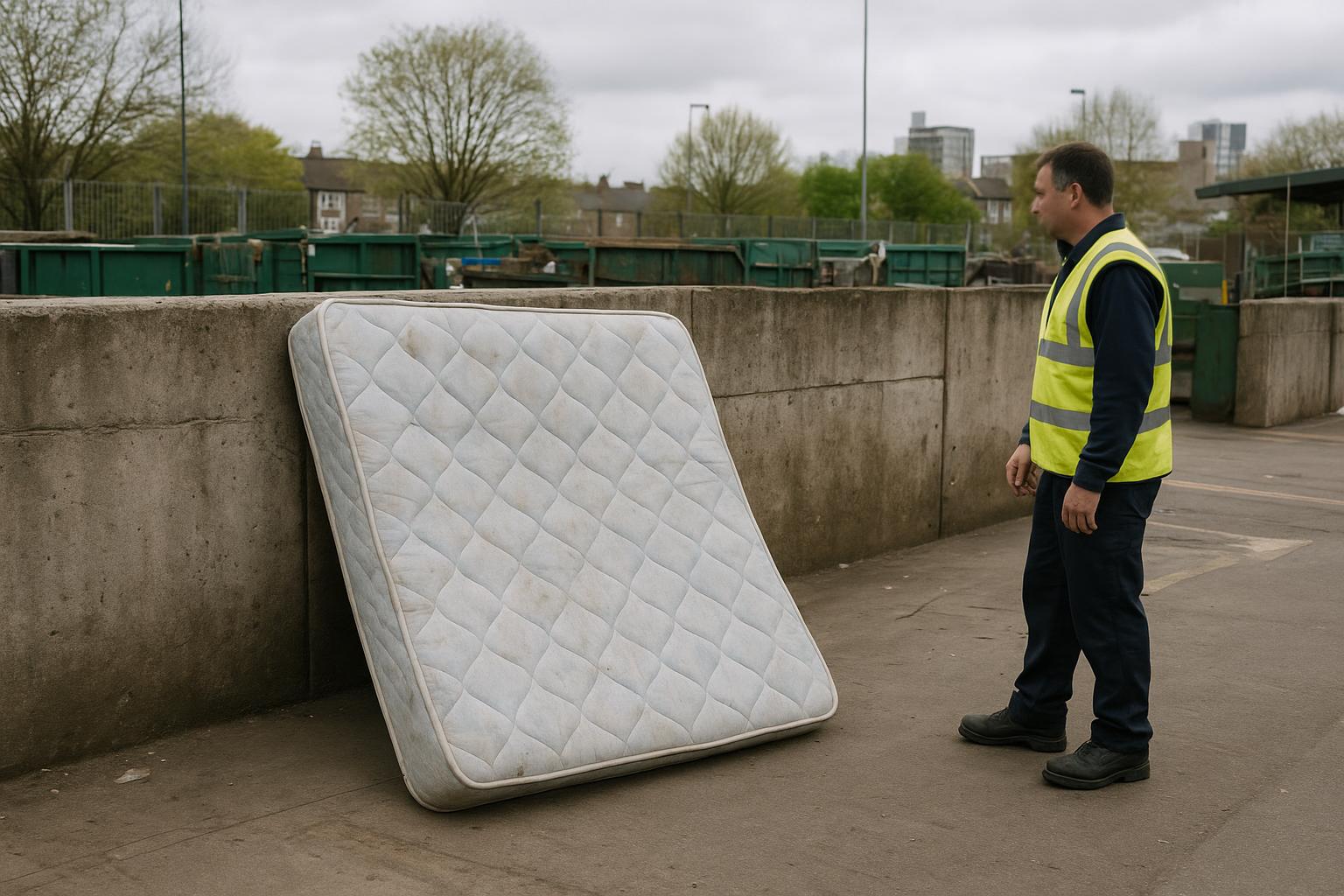
Most household waste recycling centres across the UK, including London boroughs, accept mattresses from local residents free of charge as standard household waste, provided you can get the mattress to the site yourself. What a specific site then does with it - send it for recycling or treat it as general waste - varies by council, but that doesn't usually change whether accepting it is free at the point of drop-off.
What does vary, and is worth checking on your own council's website before you load up a car or van, includes:
- Whether there's a limit on how many mattresses a household can bring per year.
- Whether you need to book a slot in advance, particularly for a van or trailer.
- Whether you'll be asked for proof of address to confirm you're a resident of that borough.
None of these conditions are universal across London - they're set borough by borough, so the only reliable way to confirm them is on the relevant council's own recycling centre page.
Retailer take-back when buying a new mattress
A common offer, but not a guaranteed or universal one.
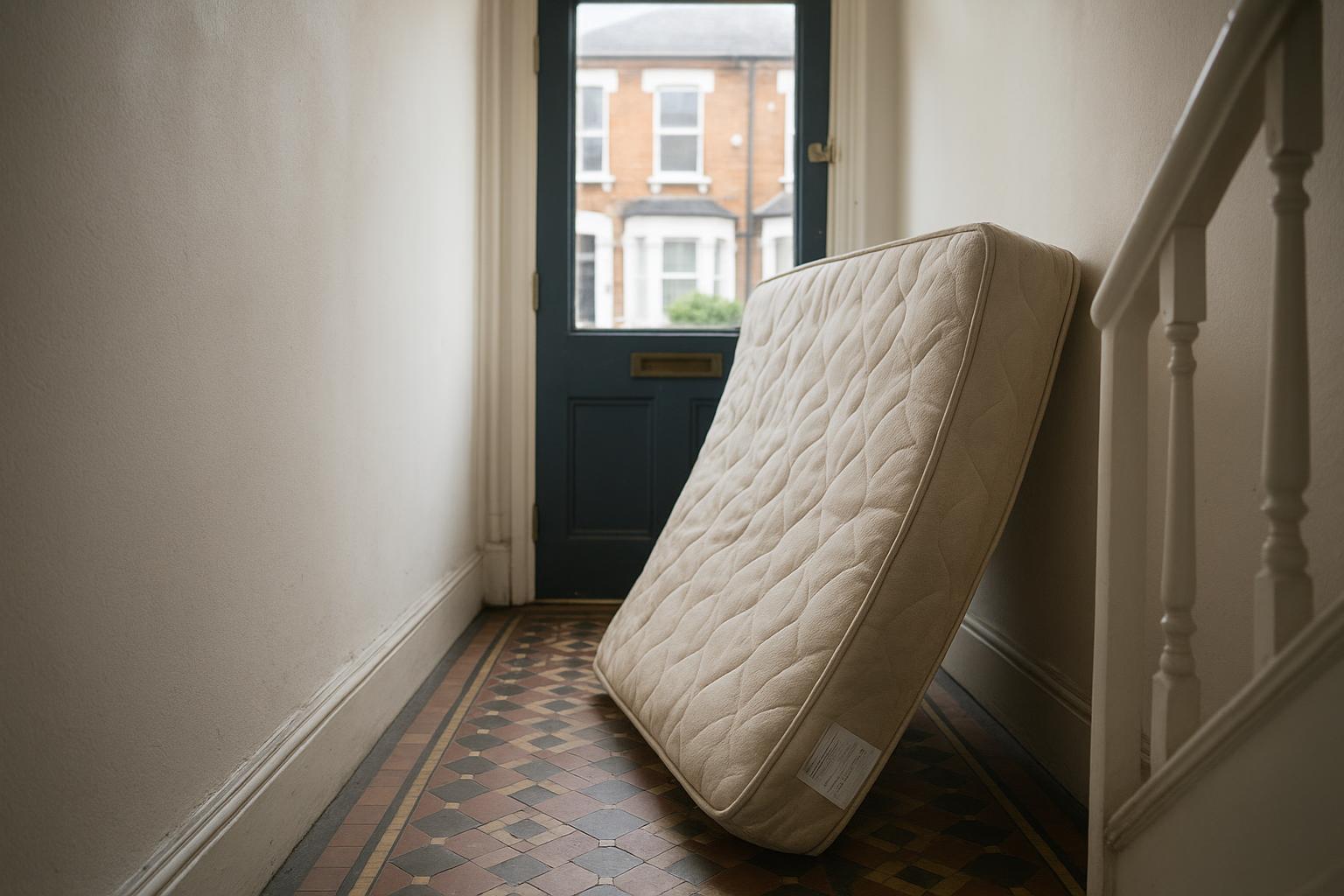
Many retailers offer to remove your old mattress when they deliver a new one, which can be a genuinely free and convenient route if you're replacing rather than simply disposing. This isn't a standard, industry-wide policy, though - whether it's offered, what it costs if anything, and what condition your old mattress needs to be in to qualify all depend on the specific retailer. It's worth confirming directly with whoever you're buying from, rather than assuming the same terms apply everywhere.
When mattress disposal stops being free
The moment someone else has to collect from your home, a charge usually applies.
The free routes above share one thing in common: either you deliver the mattress yourself, or the item meets specific donation or retailer conditions. As soon as you need the mattress collected from your home rather than dropping it off, a charge is the norm rather than the exception. A council bulky waste collection typically charges a fee that varies by borough, and a private clearance service charges for the labour and transport of collecting it, often alongside other furniture and bulky items in the same visit. If a mattress is only one part of a larger job - clearing several rooms, or a mattress along with other bulky furniture - it's often more practical to treat it as part of that wider clearance rather than trying to solve it as a single free-only task; see furniture and bulky item removal cost in London for how that's typically priced.
Why "free" often stops at the front door: what disposal actually costs
Even when the mattress leaves for nothing, someone pays for processing it.
A mattress is bulky, awkward and heavy, and it cannot simply be tipped with ordinary rubbish. Upholstered items need separate handling, and the /prices/ page explains that commercial waste stations apply gate surcharges that carriers add directly to their quotes. These figures are useful for one reason: they show you what a mattress costs to dispose of properly, so you can see what a free route is saving you and what a paid route is passing on.
| Item | Indicative surcharge |
|---|---|
| Single mattress | £25 – £40 |
| Double / king mattress | £45 – £65 |
| Armchair (upholstered) | £35 – £55 |
| 2-seater sofa | £50 – £85 |
| 3-seater sofa | £65 – £110 |
These are indicative ranges, not the price of a collection. A carrier's real quote also reflects labour, access and the rest of the load, and carriers are independent businesses, so there is no single company-wide price. Whether VAT applies depends on the carrier and is stated in the quote.
The comparison with the free routes is straightforward. If you take the mattress to a recycling centre yourself, you do the labour and transport, and the council absorbs the processing. If you ask someone to collect from your home, the labour and the processing both get priced in, which is why the answer to "is it free?" changes the moment the mattress has to be collected.
Worked examples: free route or paid route?
Illustrative arithmetic using the published ranges - not customer jobs and not quotes.
These examples use only the ranges shown above and the per-flight stairs allowance of £30 to £60 on /prices/. They are meant to show how to think about the trade-off, not to predict a price.
Example 1: one single mattress, you have a car
You have a single mattress in good shape that fits in your car and live near a recycling centre. The free route costs your time and fuel. The disposal surcharge range for a single mattress, £25 to £40, shows what a collector would be passing on in processing alone, so a collection here would cost more than this and may not be necessary at all.
Example 2: a double mattress and a three-seater sofa, upstairs flat
Imagine a double mattress and a three-seater sofa leaving a first-floor flat without a lift. Adding the two surcharge ranges gives £45 + £65 = £110 at the low end and £65 + £110 = £175 at the high end, so £110 to £175 in processing allowances alone. One flight of stairs adds £30 to £60 on /prices/, giving about £140 to £235 before any labour for the rest of the job and the minimum single-item charge that carriers set. The takeaway is that two heavy items from a flat with stairs can quickly cost more than people expect, so the free route is worth real effort if you have the means to use it.
Example 3: replacing the bed and clearing the room
If you are buying a new mattress and also clearing wardrobes and boxes, the removal of the mattress is a small part of a bigger job. In that case it is usually better to price the whole load together, because a van fraction price covers the full load rather than charging for the mattress separately. The van-load table below shows how those fractions are priced.
| Van load equivalent | Cubic capacity | Indicative London price |
|---|---|---|
| Single item minimum charge | 1 – 2 cu yd | £65 – £95 |
| 1/8 van load | 2 cu yd | £95 – £135 |
| 1/4 van load | 4 cu yd | £145 – £195 |
| 3/8 van load | 6 cu yd | £210 – £265 |
| 1/2 van load | 8 cu yd | £275 – £345 |
| 3/4 van load | 12 cu yd | £425 – £495 |
| Full van load | 16 cu yd | £575 – £695 |
Hygiene, damp and condition: which routes accept what
A mattress that is wet, soiled or infested can limit your options.
Most of the free routes assume a mattress in ordinary used condition. A mattress that is soaked, mouldy, soiled or showing signs of pests is a different matter. Charities will almost never take it, some retailers will not collect it, and a recycling centre may ask for it to be wrapped or placed in a specific container. If the mattress is in this state, wrap it in a mattress bag or heavy plastic before moving it, which keeps the problem contained and is a courtesy to whoever carries it.
Do not try to sell or give away a mattress with bed bugs. Beyond the ethical problem, it spreads the infestation to the next home, and councils and carriers will want to know about it in advance. Tell any carrier or council service about the condition when you book so that they can handle it appropriately.
- Clean and dry, label intact: best candidate for charity, retailer take-back or reuse.
- Clean but label missing or worn: generally not donatable, still acceptable at a recycling centre in most cases.
- Wet, mouldy or soiled: not suitable for donation; wrap it and use a recycling centre or a collection.
- Suspected pests: keep it sealed, tell whoever collects it, and do not give it away.
Moving a mattress safely in a London home
The practical difficulty is usually the stairs, not the paperwork.
A mattress is light for its size but awkward to turn, and a double or king can be hard to move around a London staircase or a communal landing. If you are doing the move yourself for a free drop-off, wrap the mattress, get a second person if there are stairs and measure the door and landing before you start. Folding a mattress can damage its springs and does not help much, so slide it down the stairs on its side if the layout allows.
Check the vehicle too. A mattress on a car roof is easy to lose and may be unsafe, and it is the type of load a recycling centre may turn away if it is not secured. Where the route to the vehicle is long or the stairs are narrow, a collection is often worth paying for, because the cost of doing it badly includes injury and damaged walls.
Questions to ask before you choose a route
Short list to run through, free or paid.
- Is there a limit on how many mattresses a household can drop off at the recycling centre, and do I need to book or show proof of address?
- Does the retailer remove the old mattress when delivering, and is that included in the price?
- Does the charity collect mattresses, and does it need the fire safety label to be present?
- If I pay for a collection, does the quote include the processing surcharge and any stairs allowance?
- Is the supplier a registered waste carrier whose registration I can check on the Environment Agency's public register?
Under your duty of care as the person disposing of waste, you should keep a record of who took the mattress and what it was described as. That applies even to a single mattress and costs nothing to do. For other bulky items, see our furniture and bulky item removal cost guide.
Frequently asked questions
The questions that come up most often about disposing of a mattress for free.
Is it actually free to dispose of a mattress?
It can be, but not in every case. Taking a mattress to your local household recycling centre yourself is free for residents at most councils, and some charities will collect a mattress in good, hygienic condition at no cost. What isn't free is a council bulky waste collection or a private clearance - those typically carry a charge for the labour and transport, even though the item itself goes to the same place.
Will a charity take my old mattress?
Only if it's clean, free of stains, tears or odour, and still carries its original permanent fire safety label. Most charities that resell items cannot legally accept or resell a mattress without that label attached, regardless of how good the mattress otherwise looks, so check for the label before you offer it.
Can I just take a mattress to the tip myself?
In most cases, yes - the majority of household recycling centres accept mattresses from local residents free of charge. Some councils cap how many you can bring per year, ask you to book a slot in advance, or require proof of address, so it's worth checking your specific council's page before you load the car.
Will a shop take away my old mattress when I buy a new one?
Many retailers offer to remove your old mattress when they deliver a new one, but this isn't guaranteed or free everywhere. Confirm directly with the retailer you're buying from, including whether there's a charge and whether your old mattress needs to meet any condition, such as being dry, to qualify.
Does a stained or damaged mattress rule out free disposal?
It rules out donation in almost all cases, since charities won't take anything that looks unhygienic or damaged even if the fire label is intact. It generally doesn't rule out a recycling centre visit, which accepts mattresses as standard household waste regardless of condition.
What if I need the mattress collected rather than dropping it off myself?
Then it's unlikely to be free. Council bulky waste collections and private clearance services both charge for the labour of collecting from your home, even when the mattress itself would have been accepted free at a recycling centre - the cost is for the collection, not the disposal.
Is it cheaper to take a mattress to the tip or pay for a collection?
Taking it yourself is usually free at the point of drop-off for residents, but you supply the vehicle and labour. A collection adds labour, transport and the processing surcharge, which the /prices/ page puts at £25 to £40 for a single mattress and £45 to £65 for a double or king, before other costs.
Can I put a mattress out with the normal rubbish?
Generally no. Mattresses are bulky items that councils and carriers handle separately, so check your council's bulky waste rules before leaving one on the kerb.
What if my mattress has no fire safety label?
A charity that resells items generally cannot accept it, so donation is not a realistic route. A recycling centre or collection may still take it, so check with them directly.
How do I stop a collection costing more than quoted?
Describe the mattress sizes, any other items and the stairs and parking at the property in your job post. The more detail you give, the less likely the price is to move once the carrier sees the load.
Do carriers on houseclearance.co include the disposal surcharge in their price?
Carriers are independent businesses and include regulated-item surcharges in their own quotes. The /prices/ page shows indicative ranges, and your quote is the figure that counts.
Should I wrap a mattress before moving it out?
Yes. A mattress bag or wrap keeps it cleaner and drier while it is carried through the home.
Can I ask a charity about its mattress conditions first?
Yes. Reuse schemes set their own conditions, so check with them before arranging a drop-off or collection.
Is it worth checking collection options before buying a new mattress?
Yes. Ask the retailer about old-mattress take-back when you order, so the plan is settled before delivery.
Need the mattress collected as part of a bigger clearance?
Post your job for licensed carriers to quote on, mattress included.